Bollinger Bands Squeeze: How to Catch Breakouts Before the Crowd
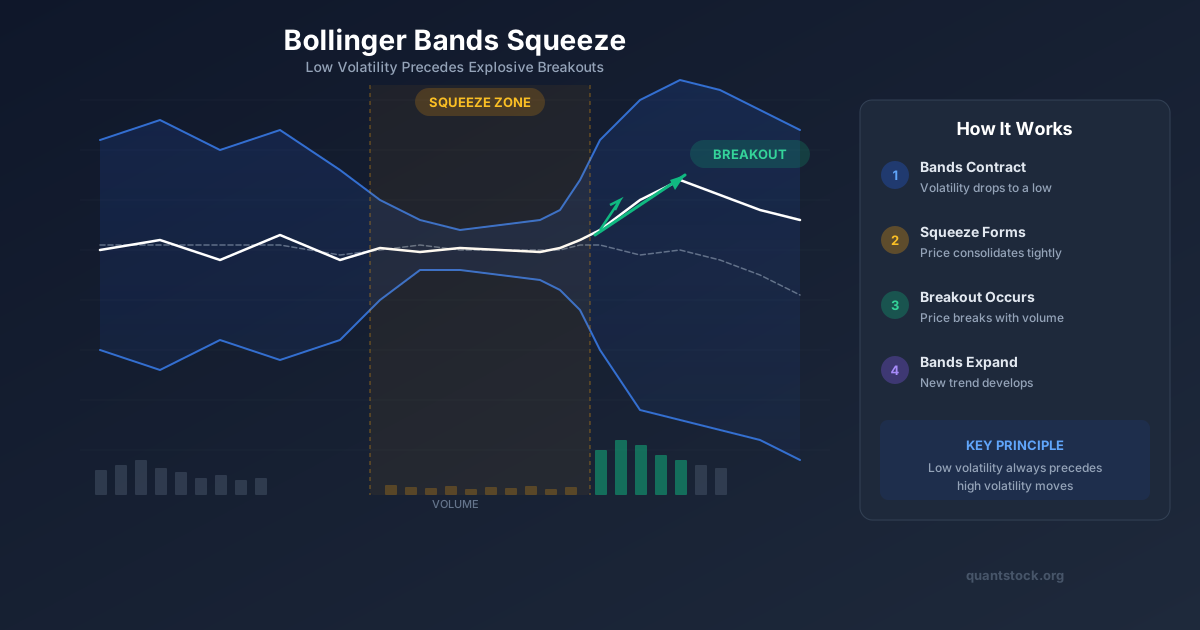
Markets spend most of their time consolidating. Prices drift sideways in tight ranges while traders wait impatiently for something to happen. Then, without warning, volatility explodes and a powerful move begins. The Bollinger Bands squeeze identifies exactly these moments.
The squeeze is one of the most visually recognizable and actionable patterns in technical analysis. When Bollinger Bands contract to their narrowest width, they signal that a significant price move is imminent. The question is not whether a breakout will occur, but in which direction. This guide teaches you how to read the squeeze, time your entry, and avoid the false breakouts that trap unprepared traders.
What Is the Bollinger Bands Squeeze?
Bollinger Bands consist of three lines: a middle line (typically a 20-period simple moving average) and two outer bands set at two standard deviations above and below the middle line. The distance between the upper and lower bands reflects current market volatility.
The squeeze occurs when these bands narrow significantly, indicating that volatility has compressed to an unusually low level. Think of it like a coiled spring. The tighter the coil, the more powerful the release. Markets cycle between periods of low volatility (consolidation) and high volatility (expansion), and the squeeze marks the transition point between the two.
Bollinger BandWidth is the quantitative measure used to identify squeezes. It calculates the percentage difference between the upper and lower bands relative to the middle band. When BandWidth drops to its lowest reading over the past six months, a squeeze is in effect.
Key characteristics of a valid squeeze setup:
- Bollinger Bands visibly contract toward the moving average
- BandWidth reaches a multi-month low
- Price action forms a tight consolidation range
- Volume typically decreases during the squeeze phase
- The squeeze resolves with a decisive move in one direction
How the Bollinger Bands Squeeze Works
Phase 1: The Contraction
Volatility compresses as buyers and sellers reach a temporary equilibrium. The upper and lower Bollinger Bands draw closer together, creating a visual narrowing on the chart. This phase can last anywhere from several days to several weeks. During this time, price typically oscillates in a tight range, and many traders lose interest in the stock.
Phase 2: The Breakout
Eventually, one side gains control. Price breaks decisively above the upper band (bullish) or below the lower band (bearish). The key word is "decisively." A strong candle that closes well beyond the band, accompanied by increasing volume, signals a genuine breakout rather than a momentary blip.
Phase 3: The Expansion
Once the breakout triggers, the bands rapidly expand as volatility surges. The initial breakout move is often the most powerful part of the new trend. Traders who entered during the breakout phase ride this expansion wave. This is where the squeeze delivers its biggest profit potential.
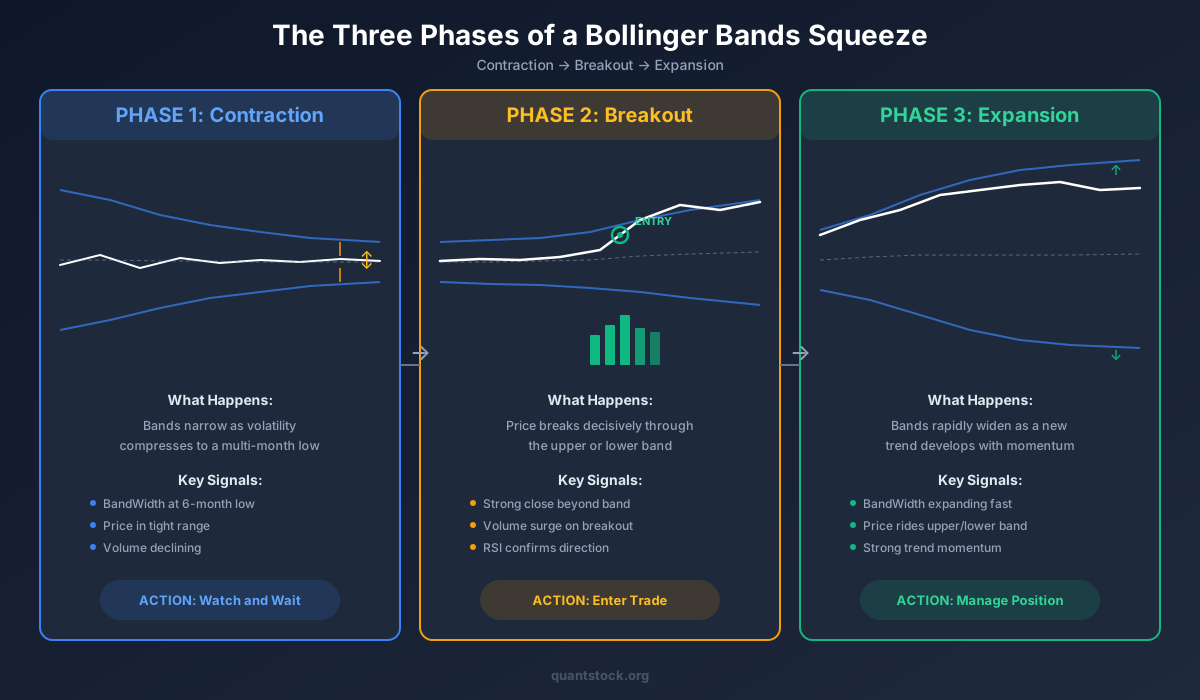
The three phases of a Bollinger Bands squeeze: contraction, breakout, and expansion
Reading Breakout Direction
The squeeze tells you that a big move is coming, but not which direction. Several context clues help determine the likely breakout direction:
- Prior trend: Squeezes that form after an uptrend tend to break upward; those after downtrends tend to break downward
- Volume patterns: Higher volume on up-days during the squeeze suggests bullish pressure is building
- Price position: If price hugs the upper half of the squeeze range, the breakout more often resolves upward
- Sector momentum: Check whether related stocks and the broader sector are trending in one direction
When the Bollinger Bands Squeeze Works Best
Ideal Market Conditions
- Stocks with cyclical volatility: Companies that alternate between quiet earnings consolidation and active trending phases (many large-cap tech stocks exhibit this pattern)
- After extended consolidation: The longer the squeeze lasts, the more powerful the subsequent breakout tends to be
- Near major events: Squeezes that form before earnings announcements, FDA decisions, or other catalysts often produce explosive moves
- In liquid markets: Highly traded stocks with tight spreads produce cleaner breakout signals
When to Be Cautious
- Low-volume penny stocks: Erratic price behavior makes squeeze signals unreliable
- During market-wide uncertainty: When the entire market is whipsawing, individual stock squeezes lose their predictive edge
- Multiple failed breakouts: If a squeeze has already produced two or three false breakouts, the pattern may be degraded
Common Mistakes Traders Make with the Squeeze
Mistake 1: Entering During the Squeeze
Problem: Buying or selling while the bands are still contracting, before any breakout has occurred. Price can remain range-bound for much longer than expected, slowly bleeding your account through chop.
Solution: Wait for a confirmed breakout candle that closes beyond the upper or lower band. Patience during the squeeze phase is what separates profitable squeeze traders from frustrated ones.
Mistake 2: Ignoring Volume on the Breakout
Problem: Treating every band break as a legitimate signal. Many false breakouts occur on low volume, trapping traders who entered too quickly.
Solution: Require above-average volume on the breakout candle. A genuine squeeze resolution should attract significant trading interest. If volume is flat or declining during the breakout, stay on the sidelines.
Mistake 3: No Exit Plan
Problem: Entering the breakout with no defined profit target or stop loss. The initial surge feels great, but without a plan, traders watch profits evaporate during the inevitable pullback.
Solution: Set your stop loss at the opposite Bollinger Band or the middle band. For profit targets, consider the width of the squeeze range projected from the breakout point. Use our risk-reward calculator to ensure each trade meets your minimum reward-to-risk ratio.
Mistake 4: Using Squeeze in Isolation
Problem: Relying solely on Bollinger Bands without checking other indicators for confirmation. This leads to trading every squeeze equally, including low-probability setups.
Solution: Combine the squeeze with RSI to check momentum conditions, or use RSI divergence signals to gauge whether the breakout has momentum backing. A squeeze breakout confirmed by RSI moving above 50 (for bullish) or below 50 (for bearish) is substantially more reliable.
Bollinger Bands Squeeze vs Keltner Channel Squeeze
Some traders use a variation called the "TTM Squeeze" which compares Bollinger Bands to Keltner Channels. When the Bollinger Bands contract inside the Keltner Channels, the squeeze is confirmed. Here is how the two approaches compare:
| Feature | Bollinger Bands Squeeze | Keltner Channel Squeeze |
|---|---|---|
| Volatility Measure | Standard deviation | Average True Range (ATR) |
| Sensitivity | More responsive to sudden changes | Smoother, less reactive |
| Signal Frequency | More squeeze signals | Fewer but often stronger signals |
| False Breakouts | More common | Less common |
| Complexity | Simple, one indicator | Requires two overlaid indicators |
For most traders, the standard Bollinger Bands squeeze is sufficient. The Keltner Channel variation adds a filter that reduces false signals but also means you miss some valid setups. Start with the simpler approach and only add complexity if your backtest results justify it.
How to Test the Squeeze Strategy Properly
The squeeze is a pattern that looks compelling on a handful of cherry-picked chart examples. But does it actually produce positive returns when applied systematically? The only way to know is rigorous backtesting.
- Define squeeze criteria: What BandWidth level constitutes a squeeze? How many days must the squeeze persist before you consider it valid? Precise rules eliminate subjectivity.
- Specify entry rules: Do you enter on the first close outside the band? Do you require volume confirmation? Define exactly what triggers a trade.
- Set exit parameters: Determine your stop loss placement (opposite band, middle band, or fixed percentage) and profit target logic before running any test.
- Test on diverse stocks: Run the strategy on high-volatility tech stocks, stable dividend stocks, and broad ETFs to see where it excels and where it struggles.
- Analyze the results holistically: Look at win rate, average win vs. average loss, maximum drawdown, and the number of trades. A squeeze strategy with 40% win rate can still be highly profitable if average wins are three times larger than average losses.
Backtest the Bollinger Bands Strategy
See how squeeze breakouts perform on your favorite stocks with real historical data
Start Backtesting Bollinger Bands GuideEnhance Your Squeeze Breakout Strategy
Bollinger Band squeezes signal upcoming volatility, but these complementary techniques help you time entries and confirm direction:
Support & Resistance vs Trendlines
Trade squeeze breakouts at key support/resistance levels for highest probability. A squeeze breakout above major resistance is far more reliable than a random breakout.
Master Support Levels →ATR Stop Loss Strategy
Use ATR-based stops for squeeze breakouts to avoid getting stopped out during initial volatility. ATR automatically adjusts stop distance based on recent volatility.
Learn ATR Stops →Volume Profile Trading
Identify high-volume nodes to predict squeeze breakout direction. Breakouts toward high-volume zones are more likely to succeed than breakouts into low-volume areas.
Master Volume Profile →Frequently Asked Questions
How long does a typical Bollinger Bands squeeze last?
Squeeze duration varies widely depending on the asset and timeframe. On daily charts, a squeeze typically lasts 5 to 20 trading days. Shorter squeezes (under 5 days) often produce weaker breakouts, while extended squeezes (20+ days) tend to produce the most powerful moves. Do not rush entries. Let the squeeze fully develop before positioning for the breakout.
What Bollinger Band settings should I use for squeeze detection?
The standard settings of 20-period moving average with 2 standard deviations work well for most stocks on daily charts. For swing trading on 4-hour charts, some traders tighten to 1.5 standard deviations to capture shorter squeezes. Avoid over-optimizing settings for a specific stock, as this leads to curve-fitting that fails on future data.
Can I trade the squeeze on ETFs like SPY or QQQ?
Yes. Index ETFs produce some of the cleanest squeeze signals because they smooth out individual stock noise. SPY and QQQ squeezes often precede significant market moves. However, the breakout magnitude on ETFs is typically smaller than on individual stocks, so adjust your profit expectations accordingly. Use our strategy screener to compare Bollinger Band performance across different ETFs.
What is the difference between a squeeze and normal band contraction?
All squeezes involve band contraction, but not all contractions are squeezes. A true squeeze requires BandWidth to reach its lowest level in at least 6 months. Normal contraction might just reflect a brief pause in volatility. The distinction matters because true squeezes produce more reliable and more powerful breakouts.
Should I combine the squeeze with RSI or MACD?
Combining indicators improves signal quality. RSI helps identify whether a breakout has momentum support (RSI above 50 for bullish, below 50 for bearish). MACD histogram turning positive or negative at the breakout point provides additional confirmation. For a detailed comparison of these indicators, read our MACD vs RSI comparison guide.
Put the Squeeze to Work in Your Strategy
The Bollinger Bands squeeze is a pattern grounded in market mechanics. Volatility contracts, energy builds, and eventually the market breaks free in a significant directional move. By identifying these setups early and waiting for confirmed breakouts, you position yourself ahead of the crowd.
Remember the essential rules:
- Wait for the squeeze, then wait for the breakout — never anticipate
- Require volume confirmation on every breakout trade
- Use additional indicators like RSI for directional bias
- Always define your stop loss and profit target before entering
- Backtest your exact rules to confirm the strategy works on your target stocks
Test Bollinger Bands on Your Watchlist
Validate squeeze breakout strategies with years of historical data
Run a Backtest Screen Strategies