Volume Profile Trading: How to Find High-Probability Entry Points Using Volume
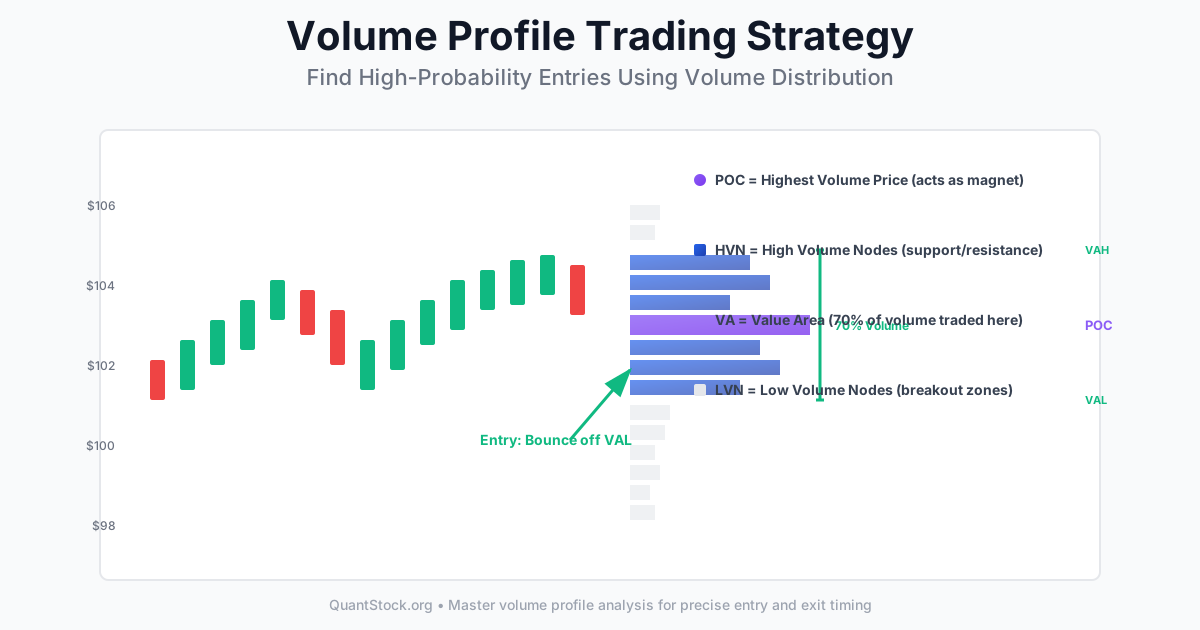
You watch price approach a support level marked on thousands of charts. Everyone sees it. Everyone trades it. But you notice something most traders miss: massive volume traded at that exact price three days ago. The level is not just a line on a chart. It represents real market memory where significant trading activity occurred.
Volume profile reveals where the most trading happened at each price level, transforming abstract support and resistance into concrete zones backed by actual transaction data. Unlike traditional indicators that focus on time, volume profile focuses on price acceptance and rejection, showing you where buyers and sellers agreed to do business in size. This guide will teach you how to read volume profile, identify key levels, and use them for precise entry and exit timing.
What Is Volume Profile?
Volume profile displays the amount of volume traded at each price level over a specified time period. Instead of plotting volume as bars at the bottom of a chart (which only shows time-based volume), volume profile plots it horizontally, showing exactly how much volume occurred at $50.00, $50.25, $50.50, and so on.
This horizontal display reveals price levels where significant trading activity concentrated. Areas with high volume represent price levels where the market spent considerable time and where buyers and sellers found equilibrium. Areas with low volume represent prices the market quickly rejected or skipped over, often becoming breakout or breakdown zones.
Volume Profile vs Regular Volume
Traditional volume bars answer the question: "How much volume occurred during this time period?" Volume profile answers a different, more actionable question: "At which prices did volume occur?"
A stock might show a huge volume spike on a traditional volume bar, but without volume profile, you cannot tell if that volume concentrated at the high, low, or middle of the day's range. Volume profile solves this ambiguity by showing the exact price distribution of that volume.
Key Volume Profile Components
Point of Control (POC)
The Point of Control is the single price level with the highest volume during the period. It represents the fairest price where the most trading occurred and where buyers and sellers agreed most enthusiastically. The POC acts as a magnet for price, frequently serving as support or resistance.
When price trades away from the POC and then returns, it often finds support or resistance there because that level represents established value. Experienced traders watch how price reacts to the POC: bounce confirms the level's importance, while a break through suggests shifting sentiment.
Value Area (VA)
The Value Area contains the price range where a specified percentage of volume occurred, typically 70%. Think of it as the price range where the market was comfortable doing business. The Value Area High (VAH) and Value Area Low (VAL) mark the boundaries of this range.
Price tends to gravitate toward the Value Area and often consolidates within it. When price trades outside the Value Area, it signals potential overextension. Many mean-reversion traders look for entries when price stretches far outside the VA, expecting a return to fair value.
High Volume Nodes (HVN)
High Volume Nodes are price levels with significantly elevated volume compared to surrounding prices. These zones represent strong support or resistance because substantial trading established acceptance at these levels. HVNs act as traffic jams where price often slows down, consolidates, or reverses.
Low Volume Nodes (LVN)
Low Volume Nodes are price levels with minimal volume, indicating the market quickly rejected these prices. LVNs often act as breakout zones. When price enters an LVN, it tends to move quickly through it because little previous trading occurred there to slow momentum. Traders use LVNs to identify where price might accelerate.
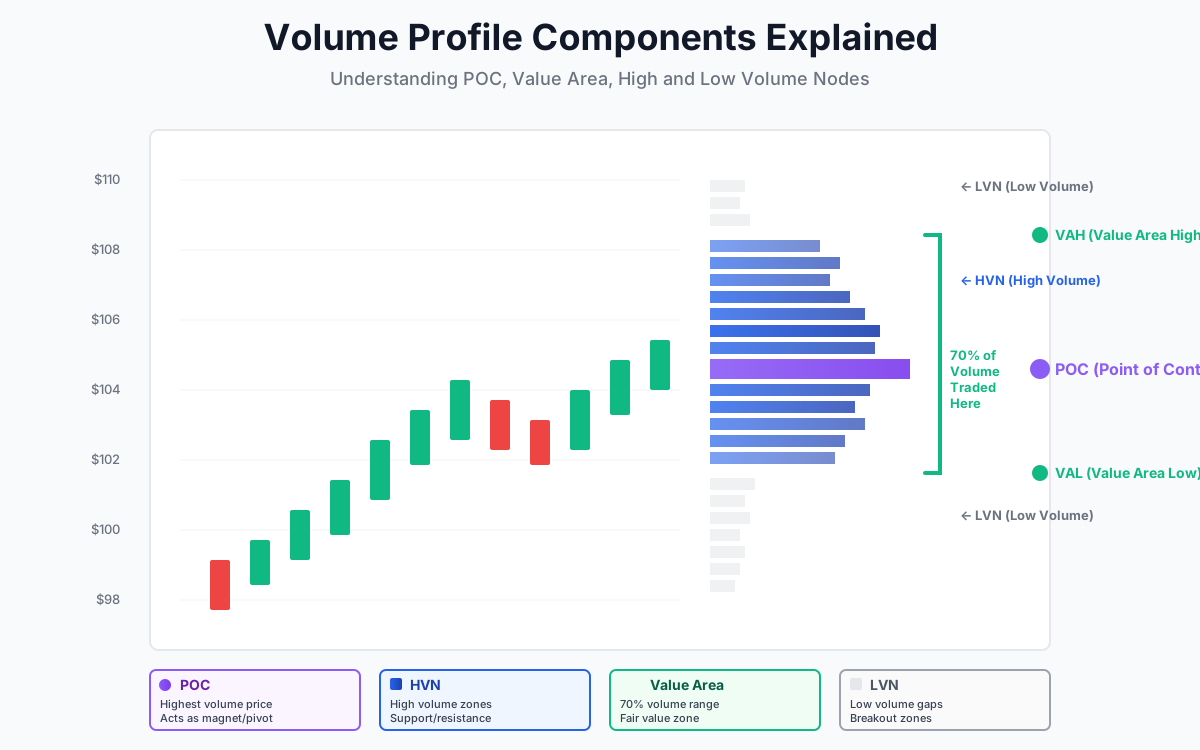
Understanding these four components unlocks high-probability entry and exit decisions
How to Use Volume Profile for Day Trading Entries
Strategy 1: Trading the POC Bounce
When price pulls back to the previous day's or previous session's POC, it often finds support or resistance. This creates a high-probability entry setup with a clearly defined risk level.
Long Setup: Price drops to the POC from above, shows bullish price action (engulfing candle, hammer, volume spike on the reversal bar), then place your entry above the reversal candle high with a stop below the POC.
Short Setup: Price rallies to the POC from below, shows bearish rejection (shooting star, bearish engulfing, declining volume on the rally), then enter short below the rejection candle low with a stop above the POC.
Strategy 2: Value Area Extremes for Mean Reversion
When price extends significantly beyond the Value Area High or Value Area Low, the market often corrects back toward fair value. This works best during range-bound conditions or after a climactic move that exhausts buyers or sellers.
Example: A stock opens inside yesterday's value area, rallies on strong volume, and pushes 2% above the VAH. Volume starts declining as price extends. This signals exhaustion. Enter short when price shows the first sign of weakness (lower high, bearish engulfing), targeting a return to the POC or VAL.
Strategy 3: Low Volume Node Breakouts
When price enters a Low Volume Node after building energy at a High Volume Node, it often accelerates rapidly through the LVN. This creates momentum breakout opportunities with reduced risk of false breakouts because the low volume confirms lack of resistance.
Setup: Identify an LVN between the current price and a key resistance level. Wait for price to consolidate at a HVN just below the LVN. When price breaks through the HVN with volume, enter long expecting rapid movement through the LVN. Place your stop below the HVN.
Pro Tip: Combine Volume Profile with Price Action
Volume profile identifies WHERE to trade. Price action tells you WHEN to enter. Never trade a volume profile level in isolation. Wait for price confirmation (candlestick pattern, volume spike, momentum shift) before entering. The combination of volume profile levels plus price action confirmation dramatically improves win rates.
Choosing the Right Volume Profile Timeframe
| Profile Type | Best For | Time Period | Use Case |
|---|---|---|---|
| Session Volume Profile | Day traders | Current trading session only | Intraday support/resistance, real-time POC tracking |
| Daily Volume Profile | Swing traders | Single trading day | Overnight levels, gap fill zones, previous day's value area |
| Weekly Volume Profile | Position traders | 5 trading days | Swing entry levels, intermediate-term support/resistance |
| Composite Profile | All traders | Multiple sessions combined | Major support/resistance zones, longer-term fair value |
Day traders typically use a combination of timeframes. The previous day's volume profile provides overnight levels and initial reference points. The current session's developing profile shows real-time value shifts. Weekly or composite profiles identify major zones unlikely to change quickly.
Session vs Composite Profiles
Session profiles reset each day (or each session), providing fresh levels based on current price action. These are dynamic and responsive but can be noisy.
Composite profiles aggregate volume across multiple days or weeks, revealing longer-term areas of price acceptance. These levels carry more weight but update more slowly. The composite POC often represents a major support or resistance level that persists for weeks.
Common Volume Profile Patterns
P-Shaped Profile (Trend Day)
Volume concentrates near the top of the day's range with a tail extending below. This indicates strong buying throughout the session with sellers unable to establish control. The POC near the high suggests participants accepted higher prices. The next day, the POC often acts as support.
B-Shaped Profile (Reverse Trend Day)
The opposite of a P-shape. Volume clusters near the low with a tail above. This shows relentless selling with buyers unable to defend higher prices. The POC near the low becomes resistance if price attempts to recover.
D-Shaped Profile (Normal Distribution)
Volume forms a bell curve around the middle of the range with the POC centered. This represents a balanced day where price explored both directions and settled near the middle. These profiles often appear during range-bound conditions. The POC acts as a pivot point for the next session.
Double Distribution Profile
Two separate volume clusters with a low volume gap between them. This indicates two distinct periods of price acceptance separated by a rapid transition. The gap often becomes a support or resistance zone, and the two POCs provide multiple reference levels for trading.
Volume Profile vs VWAP: Which Should You Use?
Volume Profile and VWAP (Volume Weighted Average Price) both incorporate volume into price analysis, but they serve different purposes and excel in different scenarios.
| Feature | Volume Profile | VWAP |
|---|---|---|
| What It Shows | Volume distribution across prices | Average price weighted by volume |
| Display Type | Horizontal histogram by price | Single line on price chart |
| Best Use | Identifying specific support/resistance levels | Determining fair value and trend direction |
| Entry Precision | Precise levels (POC, VAH, VAL) | Dynamic average (moves continuously) |
| Market Regime | Excellent in ranging markets | Excellent in trending markets |
| Information Density | High (shows entire distribution) | Low (single value) |
Many professional day traders use both. VWAP provides a dynamic benchmark for fair value throughout the session. Volume profile provides specific levels where price is likely to react. When price pulls back to both the VWAP and a high volume node simultaneously, the confluence creates an extremely high-probability entry.
For a detailed comparison of volume-based indicators, read our guide on VWAP trading strategies.
Common Mistakes When Trading Volume Profile
Mistake 1: Trading Every Volume Profile Level
Problem: Attempting to trade every POC, VAH, VAL, and HVN without filtering for quality setups or market context.
Solution: Focus on the most significant levels: previous day's POC, current composite POC, and extreme HVNs with LVN gaps above or below. Not every volume cluster deserves a trade. Quality over quantity always wins.
Mistake 2: Ignoring Price Action Confirmation
Problem: Entering trades the instant price touches a volume profile level without waiting for confirmation of support or resistance.
Solution: Volume profile tells you where to watch, not when to enter. Always wait for price action confirmation: a reversal candle, volume spike, momentum shift, or break of a micro structure. The combination of level plus confirmation is what creates edge.
Mistake 3: Using Inappropriate Timeframes
Problem: Day trading off a weekly volume profile or swing trading off a 5-minute session profile. Timeframe mismatches create misleading signals.
Solution: Match your volume profile timeframe to your holding period. If you hold trades for 30-90 minutes, use the current session profile. If you hold for days, use daily or composite profiles. Higher timeframe profiles carry more weight but update slower.
Mistake 4: Forgetting Market Context
Problem: Trading volume profile levels mechanically without considering overall market trend, news events, or sentiment.
Solution: Volume profile works best when aligned with market context. POC support means less during a strong downtrend. VAH resistance matters less during a powerful breakout. Always ask: does the volume profile setup align with or fight against the broader market direction?
How to Backtest Volume Profile Strategies
Volume profile strategies require specialized backtesting because you need historical volume distribution data, not just price and total volume. Here is how to validate volume profile setups:
- Define specific rules: Write down exactly what qualifies as a valid setup. "Trade POC bounces" is too vague. Instead: "When price pulls back to yesterday's POC from above, shows a bullish engulfing candle, and volume increases on the reversal bar, enter long with a stop 0.2% below the POC."
- Replay historical sessions: Use trading software with volume profile capabilities to replay past trading days. Manually mark where POC, VAH, VAL appeared during the session and how price reacted. This labor-intensive process reveals which patterns actually repeat.
- Track hit rates by level type: Separately measure win rates for POC trades, VAH/VAL trades, HVN trades, and LVN breakouts. You might discover that POC bounces work beautifully but LVN breakouts fail in your market or with your timing.
- Test across market conditions: Separate trending days from ranging days and analyze performance in each regime. Volume profile typically excels in range-bound conditions but can produce false signals during strong trends.
- Measure confirmation requirements: Test different confirmation methods (candlestick patterns, volume thresholds, momentum indicators) to determine which filters improve results without over-optimizing.
Unlike simple moving average strategies, volume profile backtesting demands visual analysis and pattern recognition. Consider using a combination of automated rules for basic filtering plus manual review of actual setups to capture the nuance of volume distribution patterns.
Test Volume-Based Strategies on Historical Data
Validate your volume profile setups across different market conditions and timeframes
Start Backtesting VWAP Strategy GuideEnhance Your Volume Profile Strategy
Volume profile shows WHERE institutional traders are active. Combine it with these tools for complete market analysis:
Support & Resistance vs Trendlines
When volume profile POC aligns with horizontal support or a rising trendline, you have triple confirmation. These zones offer the highest probability reversal entries.
Master Support Levels →ATR Stop Loss Strategy
Use ATR-based stops when trading volume profile bounces. Place stops below the value area low with ATR distance for volatility-adjusted risk management.
Learn ATR Stops →EMA vs SMA Crossover Strategy
Confirm volume profile entries with EMA crossovers. Only trade POC bounces when the EMA is sloping in the direction of your trade for higher win rates.
Compare EMA vs SMA →Frequently Asked Questions
What volume profile settings are best for day trading?
Most day traders use the current session's volume profile plus the previous day's volume profile for reference levels. Set your value area to 70% (the standard), which captures the core trading range while excluding extremes. For precise intraday entries, combine the developing session profile with a 30-minute or 60-minute composite to see how volume built throughout the day.
Does volume profile work on all assets?
Volume profile works best on high-volume, liquid assets where volume data is meaningful and reliable. Stocks with average daily volume above 1 million shares provide cleaner volume profiles. Avoid using volume profile on low-volume stocks, thinly traded options, or assets with inconsistent volume patterns. Futures and major forex pairs generally work well due to centralized volume reporting.
How is volume profile different from market profile?
Volume profile measures actual volume traded at each price level. Market profile measures time spent at each price level using TPO (Time Price Opportunity) charts. Both identify value areas and frequently produce similar levels, but volume profile reflects actual transaction activity while market profile reflects time distribution. Most modern traders prefer volume profile because it directly measures market participation.
Can I use volume profile for swing trading or is it only for day trading?
Volume profile works for all timeframes. Swing traders use weekly or monthly composite profiles to identify major support and resistance zones that persist across multiple days. Position traders use even longer composite profiles to find quarterly or yearly value areas. The principles remain the same: high volume zones act as magnets and barriers, low volume zones allow rapid movement. Adjust your volume profile period to match your holding timeframe.
Should I trade when price is inside or outside the value area?
Both offer opportunities depending on your strategy. Mean reversion traders look for entries when price extends far outside the value area, expecting a return to fair value. Trend followers wait for price to break and hold outside the value area with conviction, then trade in the direction of the break. Range traders prefer trading near the value area boundaries (VAH and VAL) when price is contained within the range. Match your approach to current market regime: range-bound or trending.
Start Using Volume Profile for Better Entry Timing
Price tells you what happened. Volume profile tells you where it happened and how much conviction supported it. While most traders rely on time-based support and resistance that everyone sees, volume profile reveals the specific prices where real market participants committed capital in size.
The critical insights from this guide:
- The Point of Control (POC) marks the highest volume price and frequently acts as support or resistance
- Value Area shows where 70% of volume occurred, defining the range of price acceptance
- High Volume Nodes (HVNs) slow price movement and provide support/resistance; Low Volume Nodes (LVNs) accelerate price
- Match your volume profile timeframe to your trading timeframe for relevant levels
- Always combine volume profile levels with price action confirmation before entering trades
The difference between trading obvious chart levels and trading volume-validated levels is the difference between following the crowd and trading where the smart money established positions. Learn to read volume distribution, and you gain an edge most retail traders never develop.
Validate Volume Profile Setups with Real Data
Test POC bounces, value area reversals, and LVN breakouts across market conditions
Test Your Strategy Screen for Setups