How to Use ATR for Stop Loss Placement: Risk Management That Adapts to Volatility
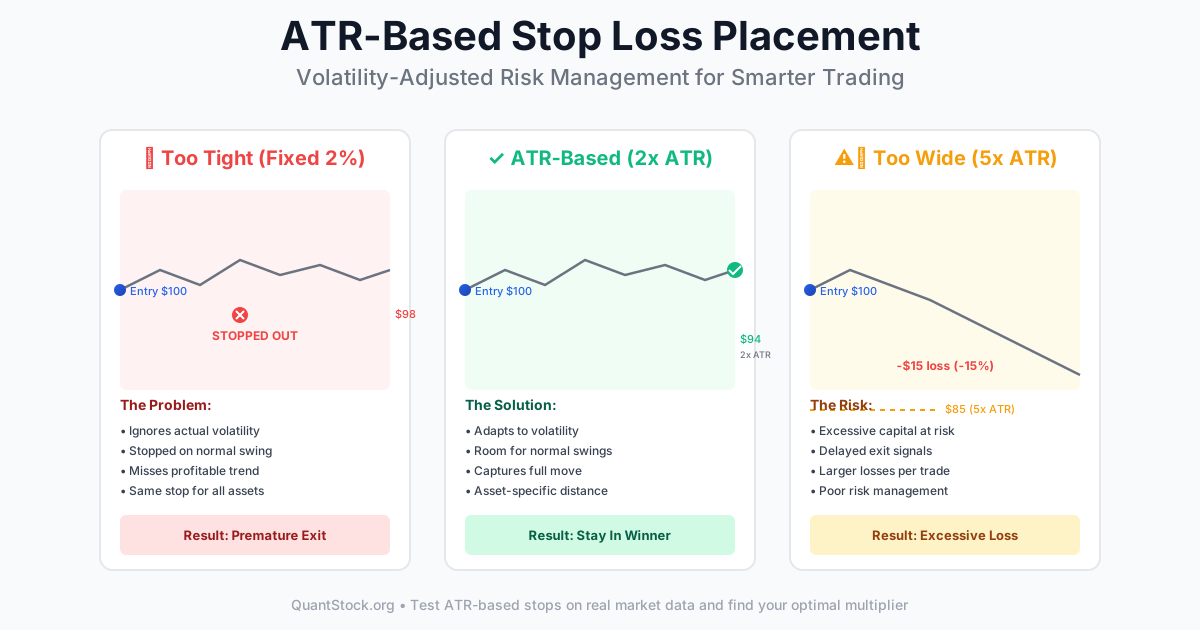
You place a stop loss 2% below your entry. The next morning, price dips 2.5% on normal volatility, stops you out, then rallies 8% without you. Meanwhile, the trader next to you stayed in the trade because their stop loss adjusted to the stock's actual movement range. They captured the entire move.
Fixed percentage stop losses ignore a critical reality: volatility changes across assets and over time. The Average True Range (ATR) indicator solves this by measuring how much an asset typically moves, allowing you to set stop losses that adapt to current market conditions. This guide will show you exactly how to calculate, place, and manage ATR-based stop losses for better risk control.
What Is ATR and Why Use It for Stop Losses?
The Average True Range (ATR) measures market volatility by calculating the average range between the high and low prices over a specified period, typically 14 days. Unlike fixed percentage stops, ATR automatically adjusts to the asset's actual movement patterns.
A stock that regularly swings 5% daily requires wider stops than one that moves 0.5% daily. Using the same 2% stop on both assets makes no sense. The volatile stock will stop you out on normal fluctuations, while the stable stock gives away unnecessary risk tolerance. ATR-based stops solve this by scaling stop distance to the asset's behavior.
How ATR Is Calculated
For each period, the True Range is the greatest of:
- Current High minus Current Low
- Current High minus Previous Close (absolute value)
- Current Low minus Previous Close (absolute value)
The ATR is then the average of these True Range values over your chosen lookback period (usually 14). The result is expressed in the same units as the asset's price, not as a percentage. If a stock trades at $100 and has an ATR of $3, the average daily range is $3.
Basic ATR Stop Loss Formula
The standard approach uses a multiplier applied to the ATR value:
Long Position: Stop Loss = Entry Price - (ATR × Multiplier)
Short Position: Stop Loss = Entry Price + (ATR × Multiplier)
Practical Example
Suppose you're buying a stock at $100, and the 14-day ATR is $2.50:
- With 1x ATR multiplier: Stop = $100 - (2.50 × 1) = $97.50
- With 2x ATR multiplier: Stop = $100 - (2.50 × 2) = $95.00
- With 3x ATR multiplier: Stop = $100 - (2.50 × 3) = $92.50
The multiplier determines how much breathing room you give the trade. Lower multipliers mean tighter stops and more frequent stop-outs. Higher multipliers provide more room but risk larger losses per trade.
Choosing the Right ATR Multiplier
| Multiplier | Trading Style | Stop Distance | Pros | Cons |
|---|---|---|---|---|
| 1x ATR | Day trading, scalping | Very tight | Limits loss per trade; quick exits | High stop-out rate; misses reversals |
| 1.5x ATR | Active day trading | Moderate-tight | Balanced for intraday swings | Still vulnerable to volatility spikes |
| 2x ATR | Swing trading (most common) | Moderate | Accommodates normal volatility; fewer false stops | Larger loss per trade if stopped |
| 3x ATR | Position trading, trend following | Wide | Survives volatility; captures big moves | Significant capital at risk; delayed exits |
| 4x+ ATR | Long-term investing | Very wide | Ignores short-term noise entirely | Potentially massive drawdowns |
Most swing traders find the sweet spot at 2x ATR. This setting provides enough room to avoid getting stopped out on routine fluctuations while still protecting capital if the trade thesis breaks down. Day traders often use 1.5x ATR or lower, accepting more frequent stops in exchange for tighter risk control.
ATR Period Settings: Which Lookback Works Best?
The Standard: 14-Period ATR
The 14-period ATR is the industry default and works well across most markets and timeframes. It provides enough data to smooth out single-day anomalies while remaining responsive to genuine shifts in volatility. Unless you have a specific reason to change it, start with 14 periods.
Faster Response: 7 to 10 Periods
Shorter ATR periods react more quickly to volatility changes. If you trade assets with rapidly shifting volatility or use very short timeframes (5-minute, 15-minute charts), a 7 or 10-period ATR adapts faster. However, this sensitivity can also cause your stop distance to whipsaw during choppy conditions.
Smoother Readings: 20 to 50 Periods
Longer periods smooth out volatility readings and work well for position traders who hold for weeks or months. A 20 or 30-period ATR filters short-term noise and focuses on sustained volatility trends. The tradeoff is slower adaptation to actual market changes.
Pro Tip: Match ATR Period to Holding Time
If your average trade lasts 5 days, use a 10-14 period ATR. If you hold for 20 days, consider a 20-30 period ATR. Matching the ATR lookback to your intended holding period creates stops that align with your actual trading rhythm.
ATR Trailing Stops: Lock In Profits as the Trade Moves
Static stop losses protect your entry but do nothing to secure profits once the trade moves in your favor. ATR trailing stops solve this by adjusting upward (for longs) or downward (for shorts) as price moves in your direction, locking in gains while still giving the trade room to breathe.
How ATR Trailing Stops Work
For a long position, you continuously recalculate the stop as:
Trailing Stop = Highest High Since Entry - (ATR × Multiplier)
As price makes new highs, the stop moves up. It never moves down. This creates an asymmetric outcome: unlimited profit potential with capped risk that progressively tightens as profits accumulate.
Example: ATR Trailing Stop in Action
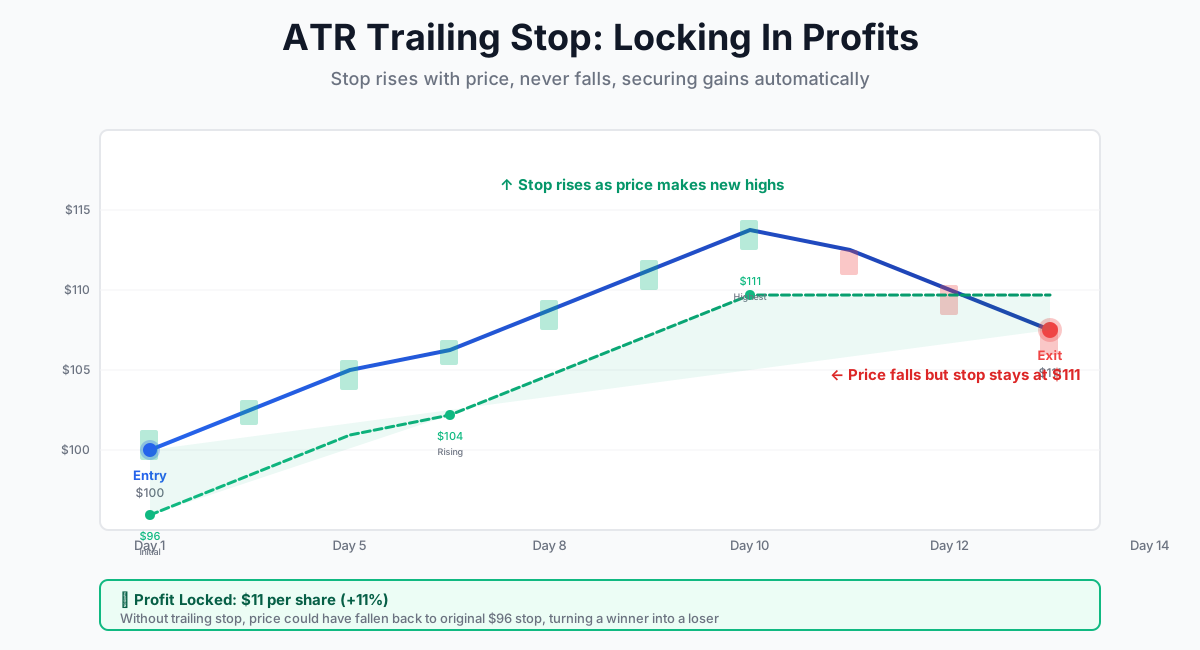
The ATR trailing stop rises with price, securing gains without choking the trade
- Day 1: Entry at $100, ATR = $2, using 2x multiplier → Initial stop at $96
- Day 5: Price reaches $108, new high → Stop moves to $104 ($108 - $4)
- Day 10: Price hits $115, new high → Stop moves to $111 ($115 - $4)
- Day 12: Price drops to $112 → Stop remains at $111 (never moves down)
- Day 14: Price falls to $110 → Stopped out at $111 with a $11 profit
Without the trailing stop, you might have ridden the position from $115 back down to your original $96 stop, transforming a winning trade into a loss or break-even. The ATR trailing stop captured most of the move automatically.
Common Mistakes with ATR Stop Losses
Mistake 1: Using the Same Multiplier for Every Asset
Problem: Applying a 2x ATR stop to both a low-volatility blue chip and a high-beta growth stock without considering their different risk profiles.
Solution: Test different multipliers on each asset class you trade. Volatile small caps might need 3x ATR to avoid false stops, while stable large caps work fine with 1.5x ATR. Let backtesting determine the optimal multiplier rather than using a one-size-fits-all approach.
Mistake 2: Ignoring Position Sizing
Problem: Using ATR to set stop distance but still risking 5% of your account because you did not adjust position size to match the wider stop.
Solution: If your ATR stop is farther from entry than usual, reduce your position size to maintain consistent dollar risk. Use our position size calculator to determine the correct share count based on your stop distance and risk tolerance.
Mistake 3: Not Updating ATR During the Trade
Problem: Calculating the ATR stop once at entry and never adjusting it as volatility changes during the holding period.
Solution: If using a trailing stop, recalculate the ATR value each day (or each bar on your timeframe). Volatility expands and contracts, and your stop should reflect current conditions, not the conditions from entry. Most trading platforms can automate this calculation.
Mistake 4: Moving Stops Closer Manually
Problem: Setting an ATR-based stop, then manually tightening it because you get nervous watching the position fluctuate.
Solution: Trust your system. You chose the ATR multiplier for a reason. Moving stops closer out of fear defeats the entire purpose of volatility-adjusted stops. If the stop feels too wide, reduce your position size instead of undermining your risk management.
ATR Stops vs Fixed Percentage Stops: Which Performs Better?
The choice between ATR-based and fixed percentage stops depends on what you trade and how you trade it.
When ATR Stops Outperform
- Diversified portfolios: If you trade multiple assets with different volatility profiles, ATR stops automatically calibrate to each one. Fixed percentage stops treat all assets the same, leading to either over-tight or over-loose risk management.
- Varying market conditions: During calm markets, ATR tightens stops to match lower volatility. During volatile periods, ATR widens stops to avoid premature exits. Fixed stops do not adapt.
- Trend-following strategies: ATR trailing stops excel at riding trends because they lock in profits while giving winning trades room to continue. Fixed stops often exit too early or too late.
When Fixed Percentage Stops Make Sense
- Strict risk control: If you need to risk exactly 1% per trade for psychological or account management reasons, fixed stops provide that certainty. ATR stops can vary significantly based on current volatility.
- Simple execution: Fixed percentage stops require zero calculation or indicator knowledge. ATR stops demand understanding of volatility measurement and periodic recalculation.
- Low-volatility assets only: If you exclusively trade stable, low-volatility assets, the advantage of ATR diminishes since volatility remains relatively constant.
For most traders managing a mix of assets across changing market conditions, ATR-based stops provide superior risk-adjusted performance. The added complexity pays off through fewer false stop-outs and better profit capture on winning trades.
How to Test ATR Stop Loss Strategies
Theoretical advantages only matter if they translate to real performance improvements. Here is how to validate whether ATR stops actually improve your results:
- Define your baseline: Run a backtest using your current stop loss method (fixed percentage or otherwise) across your preferred assets and timeframe. Record win rate, average win/loss, and maximum drawdown.
- Test multiple ATR multipliers: Run separate backtests using 1x, 1.5x, 2x, 2.5x, and 3x ATR stops. Do not assume 2x is optimal just because it is common. Your strategy and assets might perform better with different settings.
- Compare across market regimes: Break your backtest period into trending vs ranging markets. ATR stops often excel in trends but may underperform fixed stops in choppy sideways action. Understanding these regime-specific differences helps you know when to apply each approach.
- Analyze stop-out frequency: Count how often you get stopped out. If your win rate is high but profits are low, your stops might be too tight. If your win rate is low but winning trades are huge, your stops might be appropriately wide for trend-following.
- Test trailing vs static ATR stops: Compare ATR stops that stay fixed at entry level against ATR trailing stops that adjust upward. Measure profit capture on winning trades to quantify the benefit of trailing.
The goal is not to find a perfect stop loss method, but to match your stop loss approach to your actual trading style, timeframe, and asset selection. What works for a day trader scalping tech stocks will not work for a position trader holding dividend aristocrats.
Backtest ATR Stop Loss Strategies on Real Data
Test different ATR multipliers and compare performance against fixed percentage stops
Start Backtesting Risk/Reward CalculatorCombine ATR Stops with These Entry Strategies
ATR stops protect your capital, but pairing them with precise entry techniques maximizes your edge:
Fibonacci Retracement Trading
Enter at Fibonacci retracement levels with ATR-based stops for perfect risk management. The 61.8% level with a 2x ATR stop gives you optimal risk/reward on pullback entries.
Learn Fibonacci Entries →Support & Resistance vs Trendlines
Buy at support levels with ATR stops placed just below the zone. This combination gives you objective entry and exit levels based on price structure and volatility.
Master Support Levels →EMA vs SMA Crossover Strategy
Take EMA crossover entries with ATR trailing stops to lock in profits as trends develop. This combination captures momentum while automatically protecting gains.
Compare EMA vs SMA →Frequently Asked Questions
What is the best ATR multiplier for swing trading?
Most swing traders use 2x to 2.5x ATR as it provides enough room to survive normal multi-day volatility without risking excessive capital. A 2x multiplier means your stop is two times the average daily range below your entry, which typically accommodates routine pullbacks in trending markets. Always backtest on your specific assets to confirm this works for your strategy.
Should I use ATR on the daily chart or my trading timeframe?
Use the ATR from the timeframe you are trading. If you trade off 1-hour charts, use the 1-hour ATR. If you trade off daily charts, use the daily ATR. Mixing timeframes (like using daily ATR for 5-minute trades) creates mismatched stop distances that either choke your trades or expose you to unnecessary risk. The exception: some swing traders use daily ATR even when entering on shorter timeframes to ensure stops accommodate overnight volatility.
How often should I recalculate my ATR stop?
For static stops set at entry, calculate once and leave it. For trailing stops, recalculate at the close of each period (each day for daily charts, each hour for hourly charts, etc.). Modern trading platforms can automate this. Manual traders should set a reminder to update their trailing stop after market close to ensure it reflects the latest high and current ATR value.
Can ATR stops be used for options trading?
Yes, but with modifications. Apply the ATR to the underlying stock, not the option itself, since option ATR values behave differently due to time decay and implied volatility. Calculate the stock's ATR stop price, then determine the corresponding option value at that stop level. Many options traders prefer time-based or percentage-based stops due to this complexity, but ATR can still guide your underlying position management.
What happens if ATR suddenly spikes during my trade?
If using a trailing stop with continuous ATR recalculation, a volatility spike will widen your stop distance, potentially giving back some locked-in profits. This is the tradeoff for adaptive stops. Some traders use a "ratchet" approach: the trailing stop can only move in the profitable direction, never backward, even if ATR expands. This protects against volatility spikes but might stop you out more often. Test both approaches to see which fits your style.
Implement ATR-Based Risk Management Today
Stop losses that ignore volatility are stop losses that work against you. Fixed percentage stops treat a quiet utility stock the same as a high-beta tech name, leading to either unnecessary losses or excessive risk. ATR-based stops adapt to the reality of how much your assets actually move.
The essential takeaways from this guide:
- ATR measures average volatility, allowing stop losses to scale with actual price movement
- The 2x ATR multiplier works well for swing trading; day traders often use 1-1.5x; position traders use 3x+
- ATR trailing stops lock in profits while giving winning trades room to run
- Always adjust position size when using wider ATR stops to maintain consistent dollar risk
- Backtest different multipliers and periods to find what works for your specific strategy and assets
The difference between arbitrary stops and volatility-adjusted stops is the difference between fighting the market's natural rhythm and moving with it. Test ATR-based risk management on your strategies to see the improvement in stop-out rates and profit capture.
Test ATR Stop Loss Performance on Your Strategy
Compare different ATR multipliers and trailing stop variations with historical data
Run a Backtest Calculate Position Size