MACD vs RSI: Which Indicator Should You Actually Use?
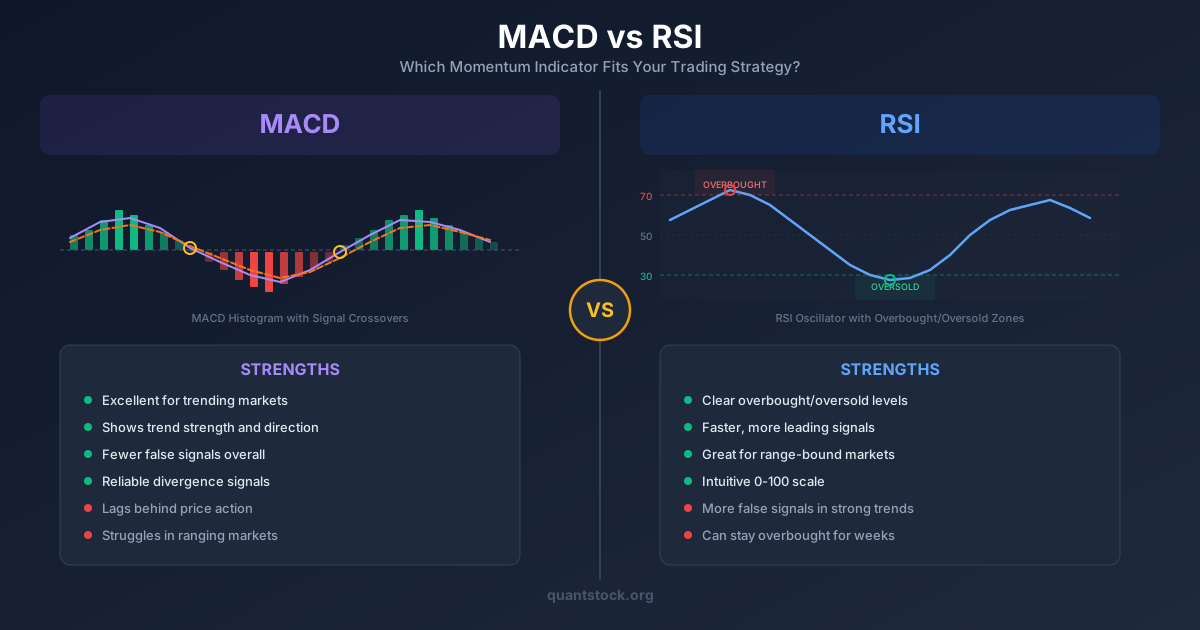
MACD and RSI are the two most widely used momentum indicators in technical analysis. Nearly every charting platform includes both. Every trading education course covers both. Yet most traders never fully understand when to use one over the other, or how to combine them effectively.
This is not a question with a simple answer. MACD excels in certain market conditions where RSI struggles, and vice versa. The right choice depends on your trading style, the market environment, and the specific stocks you trade. This guide breaks down the strengths and weaknesses of each indicator so you can make an informed decision based on data, not opinions.
What Is MACD?
The Moving Average Convergence Divergence (MACD) measures the relationship between two exponential moving averages of price. The standard settings use the 12-period and 26-period EMAs. The MACD line is the difference between these two averages, and the signal line is a 9-period EMA of the MACD line itself.
MACD generates trading signals through three primary methods:
- Signal line crossovers: When the MACD line crosses above the signal line (bullish) or below it (bearish)
- Zero line crossovers: When the MACD crosses above zero (uptrend confirmation) or below zero (downtrend confirmation)
- Divergence: When price and MACD move in opposite directions, warning of a potential reversal
MACD is classified as a trend-following momentum indicator. It tells you whether a trend exists, how strong it is, and when it may be changing direction. Because it is built from moving averages, it inherently lags behind price action. For a complete breakdown, see our MACD strategy guide.
What Is RSI?
The Relative Strength Index (RSI) measures the speed and magnitude of recent price changes to evaluate whether an asset is overbought or oversold. The standard setting uses a 14-period lookback window and produces a value between 0 and 100.
RSI generates signals through several mechanisms:
- Overbought/oversold levels: Readings above 70 suggest overbought conditions; below 30 suggests oversold
- Centerline crossovers: RSI crossing above 50 indicates bullish momentum; below 50 indicates bearish
- Divergence: When price and RSI disagree on direction, signaling weakening momentum
- Failure swings: When RSI breaks its own support or resistance levels without corresponding price movement
RSI is classified as a leading oscillator. It attempts to identify turning points before they fully develop in price. This makes it faster than MACD but also more prone to premature signals. For deeper coverage, explore our RSI strategy guide.
How They Compare: Head-to-Head
Understanding the fundamental differences between MACD and RSI helps you select the right tool for each market situation.
| Characteristic | MACD | RSI |
|---|---|---|
| Indicator Type | Trend-following (lagging) | Oscillator (leading) |
| Primary Use | Trend direction and strength | Overbought/oversold conditions |
| Signal Speed | Slower, more confirmed | Faster, more anticipatory |
| Best Market | Trending markets | Range-bound markets |
| False Signals | Fewer in trends, many in ranges | Fewer in ranges, many in trends |
| Value Range | Unbounded (positive/negative) | 0 to 100 |
| Built-in Levels | Zero line only | 30, 50, and 70 reference levels |
| Divergence Quality | Slower but more reliable | Faster but more false positives |
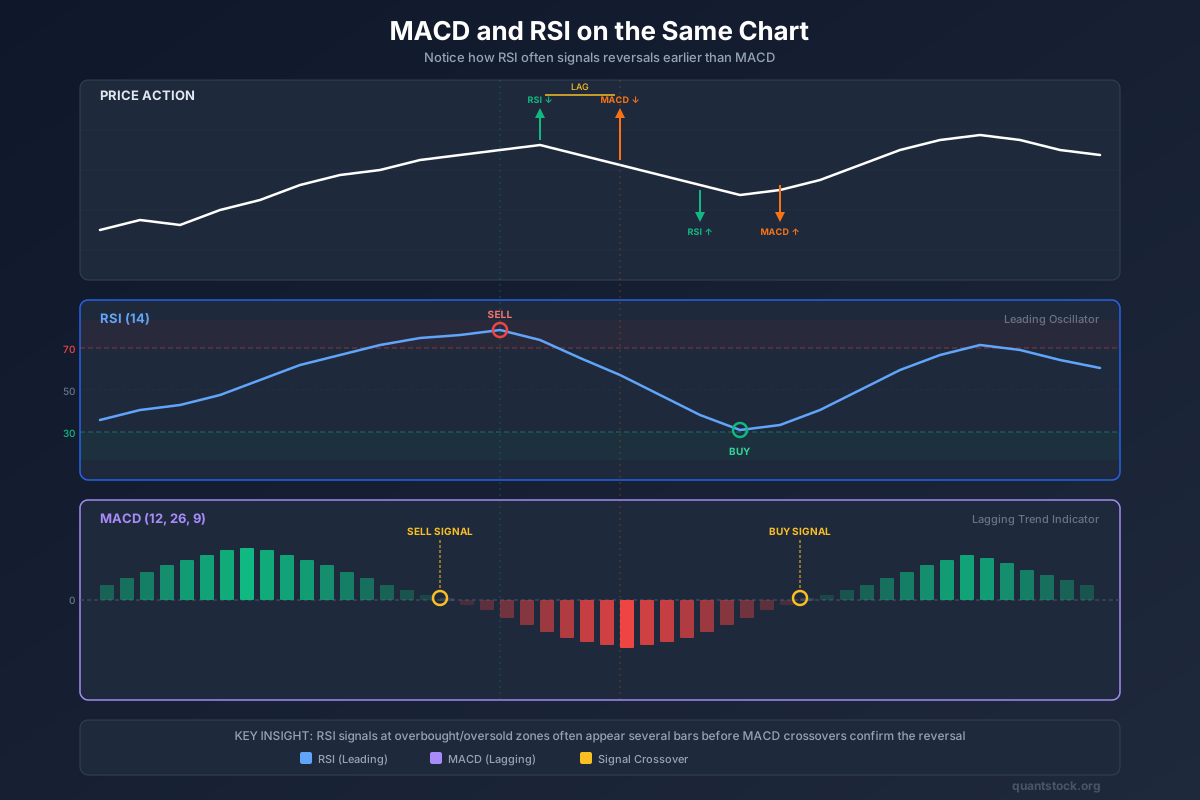
MACD and RSI shown on the same chart — notice how RSI signals often lead MACD signals
When Each Indicator Works Best
Use MACD When:
- The market is clearly trending: MACD shines when price is making sustained directional moves. It helps you stay in the trend and avoid premature exits.
- You want trend confirmation: Before entering a position based on price action or chart patterns, MACD can confirm whether momentum supports the move.
- You trade momentum stocks: High-growth stocks like those in the technology sector often produce strong MACD signals during earnings-driven rallies or sector rotations.
- You prefer fewer, higher-conviction signals: MACD generates fewer signals than RSI, which means fewer decisions to make and typically lower transaction costs.
Use RSI When:
- The market is range-bound: RSI excels at identifying buy and sell zones within established trading ranges. The 70/30 levels act as natural boundaries.
- You need overbought/oversold signals: No other common indicator provides cleaner overbought and oversold readings than RSI.
- You want early reversal warnings: RSI divergence often appears before MACD divergence, giving you an earlier heads-up about weakening trends.
- You trade mean reversion strategies: Buying oversold stocks that dip below RSI 30 and selling overbought stocks above RSI 70 is a classic mean reversion approach.
Common Mistakes When Comparing MACD and RSI
Mistake 1: Treating Them as Interchangeable
Problem: Using MACD for mean reversion or RSI for trend following. Each indicator has a domain where it excels and a domain where it struggles.
Solution: Match the indicator to the market condition. First identify whether the market is trending or ranging, then select the appropriate tool. Mismatching indicator to market is one of the most common sources of trading losses.
Mistake 2: Indicator Overload
Problem: Adding MACD, RSI, Stochastic, CCI, and Williams %R all at once. Many of these measure similar things, creating redundant and contradictory signals.
Solution: Choose one trend indicator and one oscillator. MACD plus RSI is sufficient for most trading strategies. Adding more indicators does not improve accuracy — it increases confusion.
Mistake 3: Optimizing Settings Without Backtesting
Problem: Tweaking MACD or RSI parameters based on a few chart examples. Setting RSI to 7 because it "caught" a reversal on one chart leads to overfitting.
Solution: Test any parameter change across hundreds of trades and multiple market conditions. If custom settings do not meaningfully outperform defaults in a backtest, stick with the standard parameters.
Combining MACD and RSI for Stronger Signals
The most powerful approach is not choosing one over the other — it is using both strategically. Because MACD and RSI measure different aspects of momentum, they complement each other rather than duplicate information.
Strategy 1: MACD for Direction, RSI for Timing
Use MACD to determine the trend direction. When the MACD line is above the signal line and above zero, the trend is bullish. Then use RSI pullbacks below 40 (but not below 30 in a strong uptrend) as entry opportunities. This approach keeps you trading with the trend while optimizing your entry price.
Strategy 2: Dual Divergence Confirmation
When both RSI and MACD show divergence from price simultaneously, the reversal signal is substantially stronger than either alone. RSI divergence provides the early warning, and MACD divergence confirms the shift. Trades taken on dual divergence have a higher win rate and typically produce larger moves.
Strategy 3: Volatility-Based Indicator Selection
Use Bollinger Band width to determine market state. When bands are wide (high volatility, trending), lean on MACD signals. When bands are narrow (low volatility, ranging), lean on RSI signals. This dynamic approach adapts to changing market conditions instead of forcing one indicator to work in all environments.
How to Test Which Indicator Works Best for You
Opinions about MACD vs RSI are abundant. Data is scarce. The only reliable way to determine which indicator works better for your specific trading approach is structured backtesting.
- Define identical trade management rules: Keep position sizing, stop loss, and profit target rules the same for both tests. Only change the entry signal (MACD vs RSI) so you isolate the indicator's contribution.
- Test on the same stocks and time period: Run both strategies on identical data. Comparing MACD on AAPL to RSI on NVDA tells you nothing about the indicators themselves.
- Evaluate across market regimes: Split your test period into trending and ranging segments. See which indicator outperforms in each regime, then weight your future use accordingly.
- Look beyond total return: Compare Sharpe ratio, maximum drawdown, win rate, and profit factor. An indicator that produces slightly lower returns with significantly smaller drawdowns may be the better choice for your risk tolerance.
- Test the combination: After testing each individually, test a combined approach to see if dual-indicator confirmation improves your results versus either alone.
Compare MACD vs RSI on Your Stocks
Run identical backtests with different indicators and see the data-driven answer
Start Backtesting Strategy ScreenerBuild a Complete Indicator Toolkit
MACD and RSI are powerful, but combining them with other tools creates a complete trading system:
Fibonacci Retracement Trading
Use MACD or RSI to identify trend direction, then enter at precise Fibonacci levels during pullbacks. The 61.8% retracement with MACD confirmation creates high-probability setups.
Learn Fibonacci Entries →EMA vs SMA Crossover Strategy
Combine MACD/RSI signals with moving average crossovers for double confirmation. Only take MACD bullish crosses when price is above the 50 EMA.
Compare EMA vs SMA →Support & Resistance vs Trendlines
Trade MACD/RSI signals at key support or resistance zones for maximum probability. A bullish MACD cross at major support is far more reliable than a random signal.
Master Support Levels →Frequently Asked Questions
Which indicator has a higher win rate, MACD or RSI?
This depends entirely on market conditions. In trending markets, MACD-based strategies typically produce higher win rates because they trade with the trend. In range-bound markets, RSI overbought/oversold signals tend to be more accurate. Studies show RSI may have a slightly higher overall win rate across mixed conditions, but MACD trades often have larger average wins. The best approach is to backtest both on your specific stocks and timeframe.
Can I use MACD and RSI together without conflicting signals?
Yes. The key is assigning each indicator a specific role rather than expecting both to agree on every trade. Use MACD for trend direction (is the trend up or down?) and RSI for entry timing (is this a good price to enter?). Conflicting signals between the two actually provide useful information — they suggest the setup lacks conviction, and staying out of the trade is the smart move.
Are there better alternatives to both MACD and RSI?
Other indicators like Stochastic Oscillator, ADX, and CCI have their advocates. However, MACD and RSI have stood the test of time because they are simple, well-understood, and effective in their respective domains. Before searching for "better" indicators, make sure you have fully exploited the potential of MACD and RSI through proper parameter tuning and systematic testing.
What timeframe works best for MACD and RSI?
MACD works well on daily and weekly charts for swing trading, and on 1-hour and 4-hour charts for shorter-term trades. RSI is effective across all timeframes but produces the most reliable overbought/oversold signals on daily charts and above. Both indicators become increasingly noisy on very short timeframes (1-minute, 5-minute charts).
Should beginners start with MACD or RSI?
RSI is generally easier for beginners because the 0-100 scale with clear overbought (70) and oversold (30) levels is intuitive to interpret. MACD requires understanding moving average relationships, signal line crossovers, and histogram interpretation, which involves a steeper learning curve. Start with RSI, gain confidence reading momentum, then add MACD to your toolkit for trend analysis.
Choose Your Indicator Based on Data, Not Opinion
The MACD vs RSI debate has no universal winner. MACD is the better tool for trending markets and trend confirmation. RSI is the better tool for range-bound markets and overbought/oversold detection. The most effective traders use both, assigning each indicator to the role it performs best.
Your action steps from here:
- Identify whether your target stocks tend to trend or oscillate in ranges
- Select the indicator that matches the dominant market behavior
- Backtest your approach with strict rules and realistic expectations
- Consider combining both indicators for higher-conviction setups
- Review and adapt as market conditions change
Do not take anyone's word for which indicator is "better." Test it yourself on the stocks you actually trade, with the timeframes you actually use. The backtesting data will give you a definitive answer personalized to your strategy.
Find Out Which Indicator Works Best for Your Stocks
Backtest MACD and RSI strategies side by side with real historical data
Start Backtesting All Strategy Guides