RSI Divergence Trading: How to Spot Reversals Before They Happen

A stock hits a new high, and the crowd rushes in to buy. But hidden beneath the surface, momentum is fading. The price keeps climbing while the RSI quietly forms a lower high. Days later, the reversal hits hard. Traders who spotted the divergence were already positioned. Everyone else scrambles.
RSI divergence is one of the most reliable early warning signals in technical analysis. It reveals when the momentum behind a price move is weakening, often well before the actual reversal occurs. In this guide, you will learn exactly how to identify, interpret, and act on RSI divergence signals across different market conditions.
What Is RSI Divergence?
RSI divergence occurs when the direction of the Relative Strength Index (RSI) disagrees with the direction of price. While price may be making new highs or lows, the RSI tells a different story, signaling that the underlying momentum is shifting.
The RSI oscillates between 0 and 100, with readings above 70 typically considered overbought and readings below 30 considered oversold. Divergence adds another layer of analysis beyond these standard thresholds by comparing the trajectory of price action against RSI movement.
There are four types of RSI divergence that every trader should understand:
- Regular Bullish Divergence: Price makes a lower low, but RSI makes a higher low
- Regular Bearish Divergence: Price makes a higher high, but RSI makes a lower high
- Hidden Bullish Divergence: Price makes a higher low, but RSI makes a lower low
- Hidden Bearish Divergence: Price makes a lower high, but RSI makes a higher high
Regular divergence signals potential trend reversals, while hidden divergence signals trend continuation. Understanding both types gives you a significant edge when timing entries and exits.
How RSI Divergence Works
Regular Bullish Divergence
This pattern appears during downtrends. Price drops to a new low, but the RSI forms a higher low than its previous trough. This disconnect reveals that selling pressure is weakening even though price continues to decline. Buyers are gradually stepping in, absorbing the selling volume.
The most reliable bullish divergence signals occur when the RSI is below 30 during at least one of the two lows. This confirms that the asset is in oversold territory while momentum is simultaneously improving.
Regular Bearish Divergence
This pattern emerges during uptrends. Price pushes to a new high, but the RSI forms a lower high. Despite the price increase, buying momentum is fading. The rally is running on fumes. Bearish divergence near the RSI 70 level carries the strongest signal weight.
Hidden Divergence (Continuation Signal)
Hidden divergence is less intuitive but equally powerful. Instead of signaling reversals, it signals that the current trend is likely to continue. Hidden bullish divergence appears when price holds a higher low while RSI dips to a lower low, then bounces. The trend absorbs the temporary weakness and resumes its upward path.
Hidden bearish divergence works in reverse. Price makes a lower high while RSI makes a higher high, suggesting the downtrend will continue despite the brief RSI uptick.
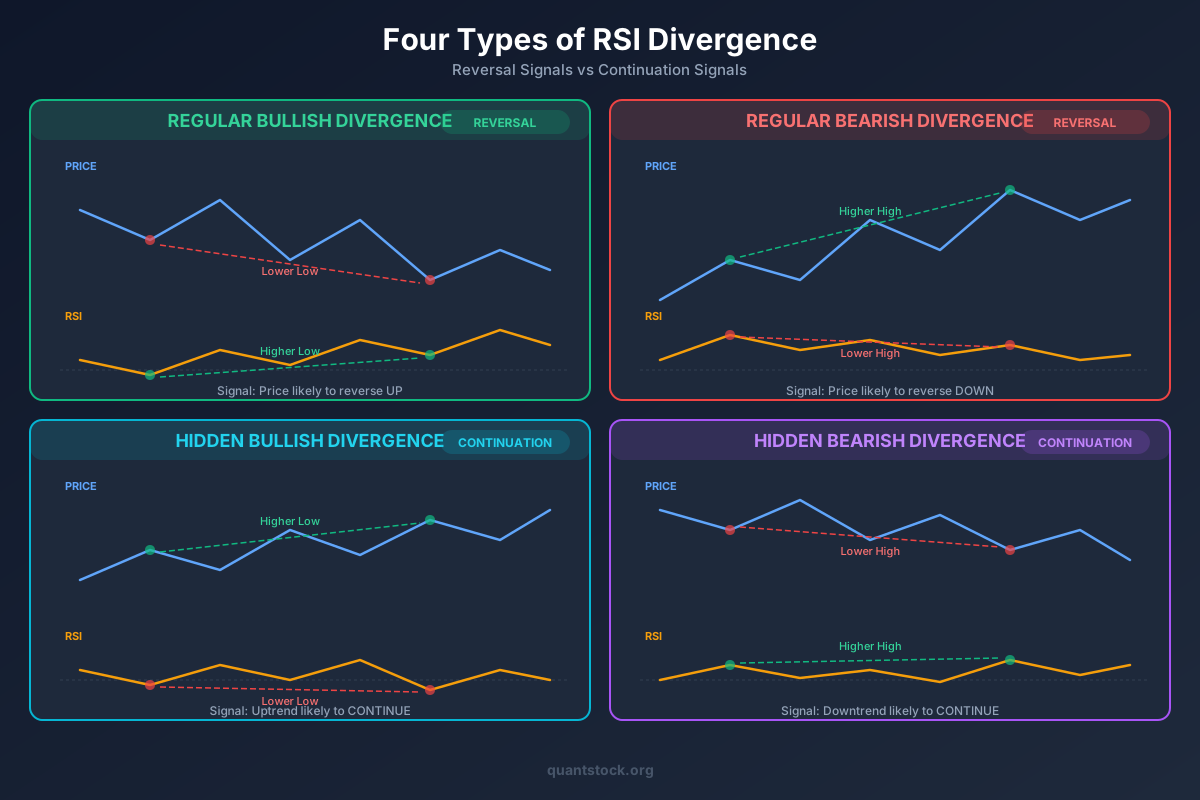
The four types of RSI divergence and their expected outcomes
When RSI Divergence Works Best
RSI divergence is not equally effective in all market environments. Understanding when to rely on it and when to be skeptical will dramatically improve your results.
Strong Signal Conditions
- Higher Timeframes: Daily and weekly charts produce more reliable divergence signals than 5-minute or 15-minute charts. Noise diminishes as the timeframe increases.
- Extreme RSI Levels: Divergence near the 70/30 boundaries carries more weight than divergence in the neutral 40–60 zone.
- Support and Resistance Confluence: When divergence aligns with a key support or resistance level, the probability of a reversal increases significantly.
- Volume Confirmation: Declining volume during the second price extreme (high or low) strengthens the divergence signal.
Weak Signal Conditions
- Strong Trending Markets: During powerful trends, multiple divergence signals can appear before any actual reversal. Trading against a strong trend solely based on divergence can be costly.
- Low-Volume Periods: Divergence during pre-market, after-hours, or holiday sessions tends to produce more false signals.
- Choppy Sideways Markets: When price oscillates in a tight range without clear direction, divergence signals become unreliable.
Common Mistakes Traders Make with RSI Divergence
Mistake 1: Trading Divergence in Isolation
Problem: Entering a trade the moment divergence appears, without waiting for any confirmation from price action, support/resistance, or volume.
Solution: Always wait for at least one confirmation signal. A candlestick reversal pattern, a trendline break, or a move back through a key support/resistance level makes the divergence signal actionable.
Mistake 2: Ignoring the Trend
Problem: Trying to catch a reversal during a powerful trending move. Bearish divergence can persist for weeks during a strong bull run.
Solution: Treat regular divergence as a warning signal, not an immediate entry trigger. During strong trends, use hidden divergence to trade with the trend instead of against it.
Mistake 3: Using Wrong RSI Settings
Problem: Using a very short RSI period (like 5 or 7) which generates excessive noise and false divergence signals.
Solution: Stick with the standard 14-period RSI for divergence analysis. If you want faster signals, go no lower than 9 periods, and increase your confirmation requirements accordingly.
Mistake 4: Forgetting Risk Management
Problem: Sizing positions too aggressively because the divergence signal looks "perfect."
Solution: Always set a stop loss beyond the recent swing high or low. No divergence signal works 100% of the time. Use our position size calculator to determine appropriate trade sizing based on your risk tolerance.
RSI Divergence vs MACD Divergence
Both RSI and MACD can produce divergence signals, but they measure momentum differently. Understanding when to use each gives you better signal quality.
| Feature | RSI Divergence | MACD Divergence |
|---|---|---|
| Signal Speed | Faster, more leading | Slower, more lagging |
| False Signals | More frequent in strong trends | Fewer but can be late |
| Best Market | Range-bound and mild trends | Trending markets |
| Overbought/Oversold | Built-in (70/30 levels) | Not directly available |
| Trend Strength | Limited trend info | Better trend indication |
Many experienced traders use both simultaneously. RSI divergence provides earlier alerts, while MACD divergence provides confirmation. When both indicators show divergence at the same time, the reversal probability increases substantially. For a deeper comparison of these two indicators, read our guide on MACD vs RSI: which indicator fits your strategy.
How to Test RSI Divergence Properly
Before risking real capital on any divergence-based approach, you need to validate it against historical data. Here is a structured approach to testing RSI divergence signals:
- Define clear rules: Specify exactly what qualifies as divergence for your strategy. How many bars between the two RSI points? What minimum RSI difference counts? Removing ambiguity prevents curve-fitting.
- Select your universe: Choose the stocks or assets you plan to trade. Divergence behaves differently on high-beta growth stocks versus low-volatility blue chips.
- Test across market cycles: Run your test over at least two years to cover both trending and ranging conditions. A strategy that only works in one regime is fragile.
- Measure risk-adjusted returns: Look at Sharpe ratio and maximum drawdown, not just total return. A divergence strategy might catch great reversals but expose you to deep losses in between.
- Compare against benchmarks: Test RSI divergence against simple RSI overbought/oversold signals to see if the added complexity actually improves performance.
The most effective way to validate these signals is through systematic backtesting. Instead of manually scrolling through charts, run your exact rules against years of historical data to get statistically meaningful results.
Backtest RSI Divergence on Any Stock
Validate divergence signals with real historical data before risking capital
Start Backtesting RSI Strategy GuideStrengthen Your Divergence Trading with These Strategies
RSI divergence signals potential reversals, but combining it with other tools dramatically improves accuracy. Master these complementary techniques:
EMA vs SMA Crossover Strategy
Use moving average crossovers to confirm trend direction before trading RSI divergence. Only take bullish divergences when price is above the 200 SMA.
Compare EMA vs SMA →Support & Resistance vs Trendlines
Look for RSI divergence at key support or resistance zones for highest probability reversals. When divergence aligns with a major level, win rate jumps significantly.
Master Support Levels →Fibonacci Retracement Trading
Combine RSI divergence with Fibonacci retracement levels for precise reversal entries. When divergence forms at the 61.8% Fib level, you have powerful confluence.
Learn Fibonacci Entries →Frequently Asked Questions
What RSI settings work best for spotting divergence?
The standard 14-period RSI remains the most reliable setting for divergence detection. It provides enough smoothing to filter noise while remaining responsive to genuine momentum shifts. Some swing traders use 9-period RSI for faster signals, but this increases false positives. Always pair shorter RSI periods with additional confirmation filters.
Can RSI divergence predict exact reversal points?
No. RSI divergence signals that momentum is weakening, but the actual reversal might take several bars to develop. It is a warning signal, not a precision timing tool. Use it to prepare for a potential reversal, then rely on price action confirmation to time your entry. Divergence tells you "what might happen," while price action tells you "when."
Is RSI divergence more reliable on daily or intraday charts?
Daily and weekly charts produce significantly more reliable divergence signals. Intraday charts (1-minute, 5-minute) generate frequent divergence patterns, but many are noise rather than meaningful signals. If you trade intraday, use the 1-hour chart as your minimum timeframe for divergence analysis.
Should I trade divergence against the trend or with it?
Both approaches have merit, but trading with the trend using hidden divergence is generally safer for less experienced traders. Regular divergence (counter-trend) requires precise timing and strong risk management. Hidden divergence (trend continuation) lets you enter pullbacks within an established trend, which tends to have a higher win rate.
How do I combine RSI divergence with other indicators?
The strongest setups combine RSI divergence with at least one other signal: support/resistance levels, candlestick reversal patterns, volume spikes, or Bollinger Band squeeze breakouts. When multiple signals align at the same price level, the probability of a successful trade increases substantially. Avoid stacking too many indicators, as this can lead to analysis paralysis.
Start Identifying RSI Divergence in Your Trading
RSI divergence gives you an information edge that most retail traders overlook. While others react to price alone, you can identify weakening momentum before the reversal becomes obvious on the chart.
The key takeaways from this guide:
- Regular divergence warns of potential reversals; hidden divergence confirms trend continuation
- Higher timeframes and extreme RSI levels produce the most reliable signals
- Never trade divergence in isolation — always wait for price action confirmation
- Test your divergence rules against historical data before trading with real money
The difference between profitable divergence trading and unprofitable guessing is systematic validation. Use backtesting to prove your approach works before you commit capital.
Validate Your Divergence Strategy with Real Data
Test RSI strategies across multiple stocks and market conditions
Run a Backtest Screen Strategies