Stochastic Oscillator vs RSI: Which Indicator Fits Your Trading Strategy?
You open your trading platform, add the Stochastic Oscillator to your chart, then overlay the RSI. Both flash overbought signals at different times. One crosses down while the other stays elevated. The signals conflict, and you hesitate. Which one should you trust?
The Stochastic Oscillator and Relative Strength Index are two of the most popular momentum indicators, but they measure different aspects of price action and excel in different conditions. Understanding when to use each one and how they complement each other will sharpen your entries, reduce false signals, and improve your overall trading performance.
What Are Stochastic and RSI Indicators?
The Relative Strength Index (RSI)
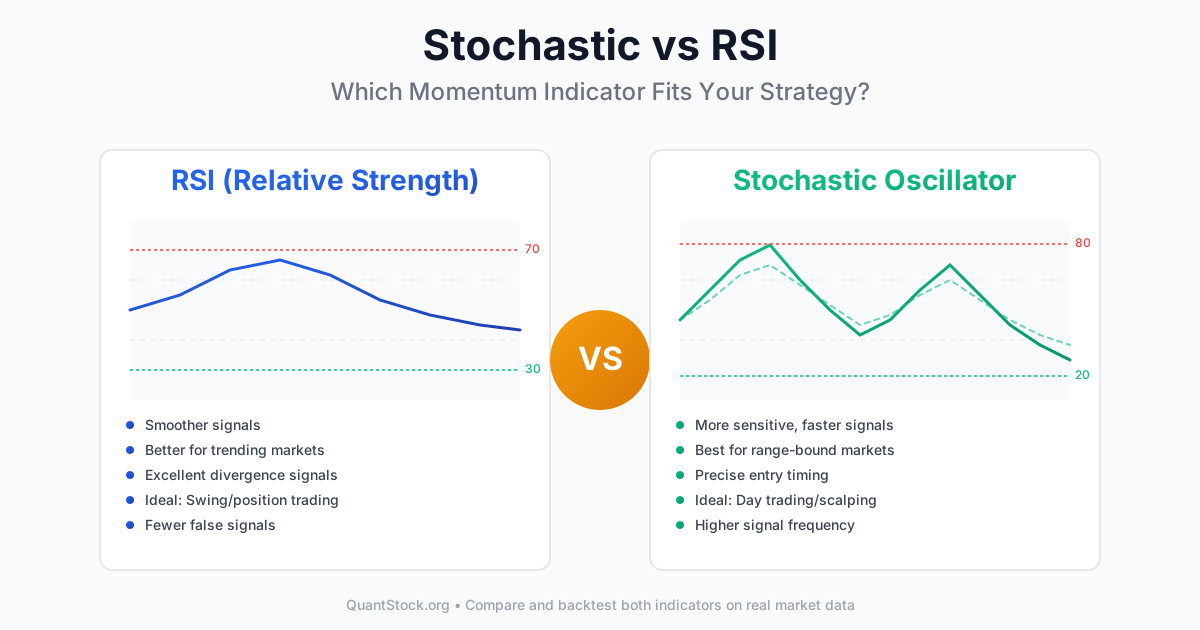
The RSI compares the magnitude of recent gains to recent losses over a specified period, typically 14 bars. It oscillates between 0 and 100, with readings above 70 signaling overbought conditions and readings below 30 indicating oversold levels.
RSI focuses on the speed and change of price movements. When calculated, it averages gains and losses over the lookback period, producing a smoothed momentum reading that reflects the overall strength of the trend rather than reacting to every minor price swing.
The Stochastic Oscillator
The Stochastic Oscillator compares the most recent closing price to the high-low range over a specific period. Instead of measuring momentum through price changes like RSI, it measures where price closed relative to its recent range.
The indicator consists of two lines: %K (the main line) and %D (a moving average of %K). Readings above 80 indicate overbought conditions, while readings below 20 signal oversold territory. The Stochastic is inherently more volatile than RSI because it reacts directly to the price range without smoothing gains and losses.
Key Differences Between Stochastic and RSI
| Feature | Stochastic Oscillator | RSI |
|---|---|---|
| Calculation Method | Compares close to high-low range | Compares average gains to average losses |
| Sensitivity to Price | More sensitive, reacts faster | Smoother, slower to react |
| Overbought/Oversold | Above 80 / Below 20 | Above 70 / Below 30 |
| Number of Lines | Two lines (%K and %D) | One line with reference levels |
| Signal Frequency | More frequent signals | Fewer, more conservative signals |
| Best Market Type | Range-bound, sideways markets | Trending markets, all conditions |
| Ideal Trading Style | Day trading, scalping | Swing trading, position trading |
| False Signals | Higher in trending markets | Lower overall, but can be late |
The fundamental difference lies in what they measure. RSI asks, "How strong is the current price momentum?" while Stochastic asks, "Where is price within its recent range?" These different perspectives create different signal patterns and reliability profiles.
When Stochastic Oscillator Works Best
Range-Bound Markets
The Stochastic Oscillator thrives when price oscillates between support and resistance without establishing a clear trend. In these conditions, the indicator's sensitivity becomes an advantage. When Stochastic drops below 20 near support and then crosses back above, it often signals a reliable bounce. When it rises above 80 near resistance and crosses back down, it warns of a potential pullback.
Short-Term Trading
Day traders and scalpers prefer the Stochastic because it generates more frequent signals. On 5-minute or 15-minute charts, the Stochastic can identify multiple entry opportunities within a single session. The %K and %D crossovers provide specific entry triggers that faster timeframes demand.
Precise Entry Timing
Even when using RSI for overall direction, many traders add the Stochastic for entry precision. RSI might confirm an oversold condition, but the Stochastic crossover pinpoints the exact moment when momentum begins to reverse. This layered approach reduces slippage and improves entry quality.
Pro Tip: Stochastic Settings
The default 14,3,3 setting works well for most traders. If you trade faster timeframes or want quicker signals, try 5,3,3. For slower, more reliable signals on daily charts, use 14,5,5. Always backtest setting changes before trading them live.
When RSI Works Best
Trending Markets
RSI handles strong trends far better than the Stochastic. During powerful uptrends, the Stochastic can remain in overbought territory for extended periods, generating repeated false sell signals. RSI also stays elevated during trends, but its smoothing mechanism produces fewer whipsaws. Traders can adjust their overbought threshold from 70 to 80 in uptrends, maintaining the indicator's usefulness without constant false exits.
Divergence Analysis
While both indicators can show divergence, RSI divergence patterns are more widely recognized and historically more reliable. When price makes a new high but RSI forms a lower high, the resulting bearish divergence often precedes significant reversals. The RSI's smoother calculation makes divergence patterns clearer and easier to identify compared to the choppier Stochastic lines.
For a complete guide on using RSI divergence to spot reversals, read our RSI divergence trading guide.
Longer Timeframes
On daily, weekly, and monthly charts, RSI provides more meaningful signals than the Stochastic. The smoothing inherent in RSI's calculation filters out noise that becomes especially problematic on higher timeframes. Position traders and swing traders typically find RSI more actionable for timing entries and exits over multiple days or weeks.
Common Mistakes When Using These Indicators
Mistake 1: Trading Overbought/Oversold Alone
Problem: Entering a trade simply because RSI hits 30 or Stochastic drops below 20, without considering trend or support/resistance.
Solution: Use overbought/oversold as context, not triggers. Wait for price confirmation, such as a bullish engulfing candle or break above a moving average, before entering.
Mistake 2: Using the Wrong Indicator for Market Conditions
Problem: Relying on Stochastic during a strong trend, or using RSI in a choppy range-bound market.
Solution: Identify the market regime first. Use ADX or moving averages to determine if the market is trending or ranging, then select the appropriate indicator. Better yet, use both and only trade when they agree.
Mistake 3: Ignoring the Crossover Signal
Problem: For Stochastic users, trading based solely on %K entering overbought/oversold zones without waiting for the %K/%D crossover.
Solution: The crossover provides the actual signal. When %K crosses above %D in oversold territory, that is your buy signal. When %K crosses below %D in overbought territory, that is your sell signal. The zones identify the location; the crossover identifies the timing.
How to Combine Stochastic and RSI
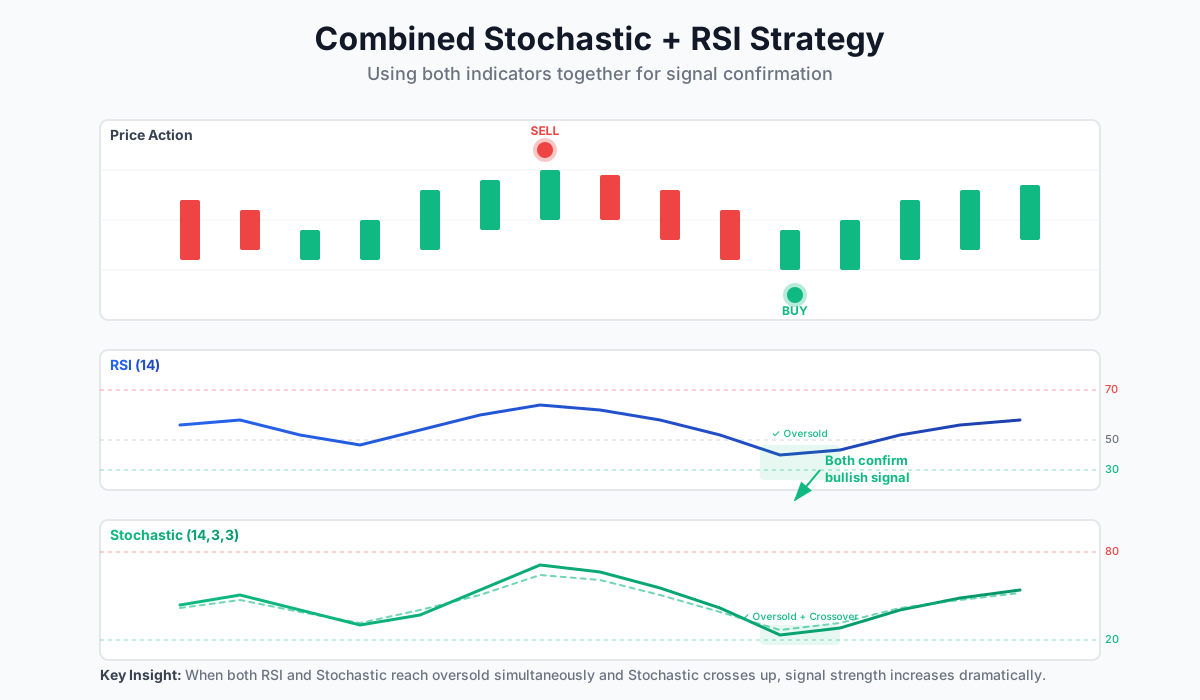
Using both indicators together reduces false signals and improves entry precision
Many professional traders use both indicators simultaneously to capture their complementary strengths. Here are three proven approaches:
Strategy 1: Dual Confirmation
Wait for both indicators to reach oversold or overbought simultaneously. When RSI drops below 30 and Stochastic falls below 20 at the same time, you have a stronger oversold signal than either indicator alone. This approach dramatically reduces false signals but also reduces signal frequency. Use this method when you prioritize quality over quantity.
Strategy 2: RSI for Direction, Stochastic for Timing
Use RSI on a higher timeframe to identify the overall market condition and trend direction. If the daily RSI is below 40, the market has bearish momentum. Then drop to a 15-minute or 1-hour chart and use the Stochastic to time precise entries in the direction of the daily RSI. This multi-timeframe approach aligns short-term entries with longer-term momentum.
Strategy 3: Stochastic for Entries, RSI for Exits
Enter trades based on Stochastic crossovers in oversold/overbought zones, but manage the exit using RSI levels. For example, enter long when Stochastic crosses above 20, then exit when RSI reaches 70. This combination captures the Stochastic's entry precision while using RSI's smoother signal for exit discipline.
How to Test Which Indicator Works for Your Strategy
The only way to know which indicator truly fits your trading style and preferred assets is through systematic testing. Theoretical advantages mean nothing if they do not translate to actual performance in your specific market conditions.
- Define clear rules: Write down exactly how you will use each indicator. For RSI, will you buy at 30 or wait for it to cross back above 30? For Stochastic, will you trade %K/%D crossovers or wait for the indicator to exit extreme zones?
- Test on multiple assets: An indicator that works brilliantly on AAPL might fail on volatile small caps. Test your rules across at least 5-10 different stocks or assets you plan to trade.
- Compare across timeframes: Run the same strategy on 5-minute, 15-minute, 1-hour, and daily charts to see where each indicator performs best.
- Measure key metrics: Look beyond win rate. Analyze average win vs average loss, maximum drawdown, and profit factor to determine which indicator produces better risk-adjusted returns.
- Test combined strategies: Run tests using RSI alone, Stochastic alone, and both together with various confirmation requirements to quantify whether the added complexity improves results.
Rather than guessing which indicator suits you better, let historical data provide the answer. Systematic backtesting eliminates bias and reveals which setups actually generate profits under realistic market conditions.
Test Stochastic and RSI Strategies on Real Data
Compare performance across different indicators, timeframes, and market conditions
Start Backtesting RSI Strategy GuideAdvanced Techniques to Boost Your Oscillator Strategy
Stochastic and RSI are powerful momentum tools, but these complementary strategies take your trading to the next level:
EMA vs SMA Crossover Strategy
Filter Stochastic/RSI signals with moving average trend confirmation. Only take bullish oscillator signals when price is above the 200 SMA for higher win rates.
Compare EMA vs SMA →Support & Resistance vs Trendlines
Trade oversold Stochastic/RSI signals at key support levels for maximum probability. When oscillator oversold aligns with horizontal support, you have powerful confluence.
Master Support Levels →Fibonacci Retracement Trading
Combine oscillator signals with Fibonacci levels for precise entries. An oversold Stochastic at the 61.8% Fib retracement creates a high-probability reversal setup.
Learn Fibonacci Entries →Frequently Asked Questions
Is Stochastic better than RSI for day trading?
Stochastic typically performs better for day trading and scalping because it generates more frequent signals and reacts faster to price changes. The %K/%D crossovers provide clear entry points on shorter timeframes. However, the higher signal frequency also means more false signals, especially during trending conditions. Most successful day traders use Stochastic for entries but combine it with trend filters or higher-timeframe RSI to reduce false positives.
Can RSI and Stochastic contradict each other?
Yes, and this happens frequently. RSI might show overbought while Stochastic is still rising, or Stochastic might cross down while RSI remains neutral. These contradictions occur because they measure different aspects of momentum. When they disagree, the safest approach is to wait for alignment or look for confirmation from price action and volume before entering a trade.
What are the best settings for Stochastic Oscillator?
The default 14,3,3 setting works well for most markets and timeframes. The first number (14) controls the lookback period for the %K calculation. The second number (3) smooths the %K line. The third number (3) is the period for the %D line (moving average of %K). For faster signals, reduce the first number to 5 or 9. For slower, more reliable signals on daily charts, increase it to 21. Always backtest setting changes on your specific assets before trading them.
Should I use Stochastic and RSI together or pick one?
It depends on your trading style and time commitment. Using both together provides stronger confirmation and reduces false signals, but it also reduces trading opportunities since you wait for dual confirmation. If you trade part-time and prefer fewer, higher-quality setups, use both. If you are a full-time day trader looking for more opportunities, pick the one that matches your preferred timeframe: Stochastic for faster charts, RSI for slower ones.
Which indicator is better for detecting divergence?
RSI is generally superior for divergence analysis. Its smoother calculation makes divergence patterns clearer and easier to identify. Stochastic can show divergence, but the two-line structure (%K and %D) and higher volatility make patterns harder to spot and less reliable. Most traders who focus on divergence trading use RSI or MACD rather than Stochastic. For more on this topic, see our guide on MACD vs RSI comparison.
Choose the Right Indicator for Your Trading Style
Neither the Stochastic Oscillator nor RSI is universally superior. Each excels in specific conditions and serves different trading approaches. Stochastic provides faster signals and sharper entry timing for day traders in range-bound markets. RSI offers smoother, more reliable signals for swing traders navigating trending markets.
The key insights from this comparison:
- Stochastic is more sensitive and generates more signals, making it ideal for short-term trading in sideways markets
- RSI is smoother and handles trends better, making it more suitable for swing trading and longer timeframes
- Using both together reduces false signals and provides confirmation, though at the cost of fewer trading opportunities
- The best indicator for you depends on your trading timeframe, preferred market conditions, and risk tolerance
Stop relying on assumptions about which indicator works better. Test both systematically on your preferred assets and timeframes to discover which one actually produces profits in your trading environment.
Backtest RSI and Stochastic Strategies Today
Compare indicator performance with real historical data across any stock or timeframe
Test Your Strategy Screen for Signals