Fibonacci Retracement Trading: Find Perfect Entry Points
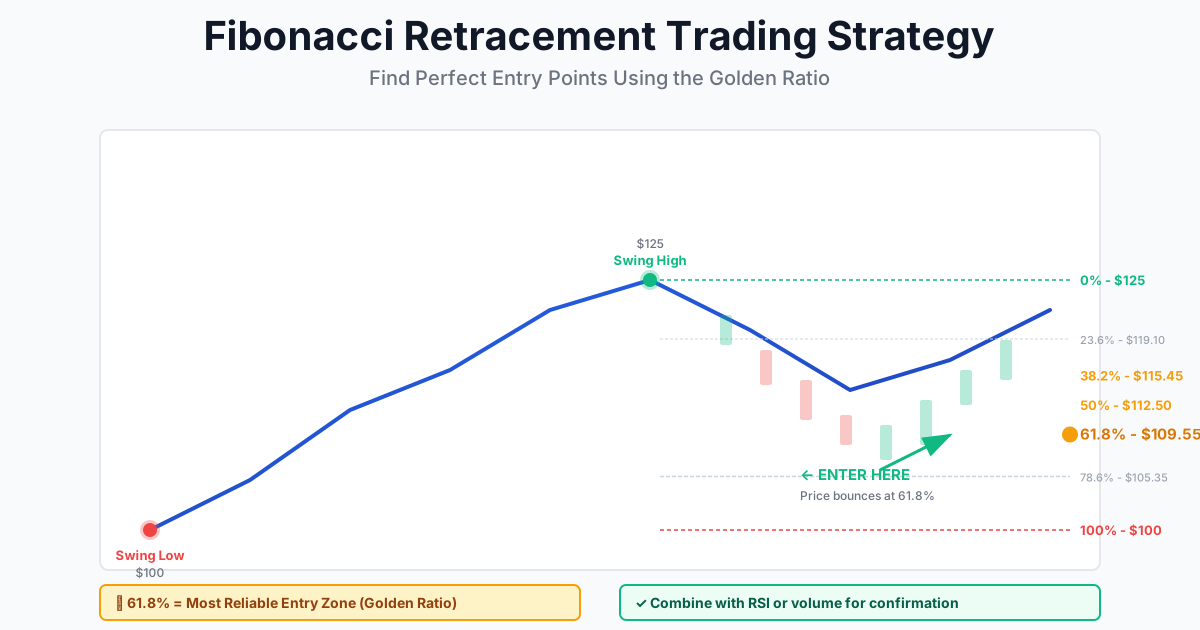
Fibonacci retracement levels identify where price might pause or reverse during a pullback, giving you high-probability entry zones instead of chasing rallies or selling panics. The technique uses ratios derived from the Fibonacci sequence—38.2%, 50%, 61.8%, and 78.6%—to map support and resistance within an established trend.
While critics dismiss Fibonacci as mystical, institutional traders and algorithms use these levels extensively. When millions of market participants watch the same levels, those zones become self-fulfilling. This article shows you how to apply Fibonacci retracements correctly, which levels matter most, and how to validate your setups with backtesting data instead of hope.
What Are Fibonacci Retracement Levels?
Fibonacci retracement levels are horizontal lines drawn at specific percentages between a significant high and low. They predict where price might find temporary support or resistance during a pullback before continuing the original trend. The key levels are:
- 23.6% – Shallow retracement, often too weak to provide good entries
- 38.2% – First major level, common in strong trends
- 50% – Not technically a Fibonacci ratio, but psychologically important
- 61.8% – The "golden ratio," most reliable retracement zone
- 78.6% – Deep retracement, signals weakening trend
These percentages come from the Fibonacci sequence (0, 1, 1, 2, 3, 5, 8, 13, 21...). When you divide any number by the next number in the sequence, you get approximately 0.618. Divide by the number two places higher and you get 0.382. These ratios appear throughout nature, and traders have found they work in markets too—not because of mysticism, but because algorithms and millions of traders use them, creating actual support and resistance.
How to Draw Fibonacci Retracement Correctly
Drawing Fibonacci levels wrong produces useless zones. Follow this process:
Step 1: Identify a Clear Trend
Fibonacci retracements only work during pullbacks within a trend. If there is no established trend, the tool is meaningless. You need a swing low and swing high separated by a meaningful price move—at minimum, a 5-10% move for stocks or a clear multi-day trend.
Step 2: Draw from Swing Low to Swing High (Uptrend)
In an uptrend, start at the lowest point (swing low) and drag to the highest point (swing high). Your charting platform will automatically plot the retracement levels downward from the high. These levels show where price might find support during the pullback.
Step 3: Draw from Swing High to Swing Low (Downtrend)
In a downtrend, reverse it: start at the highest point and drag down to the lowest point. The retracement levels will appear upward from the low, showing potential resistance zones where price might stall during a bounce.
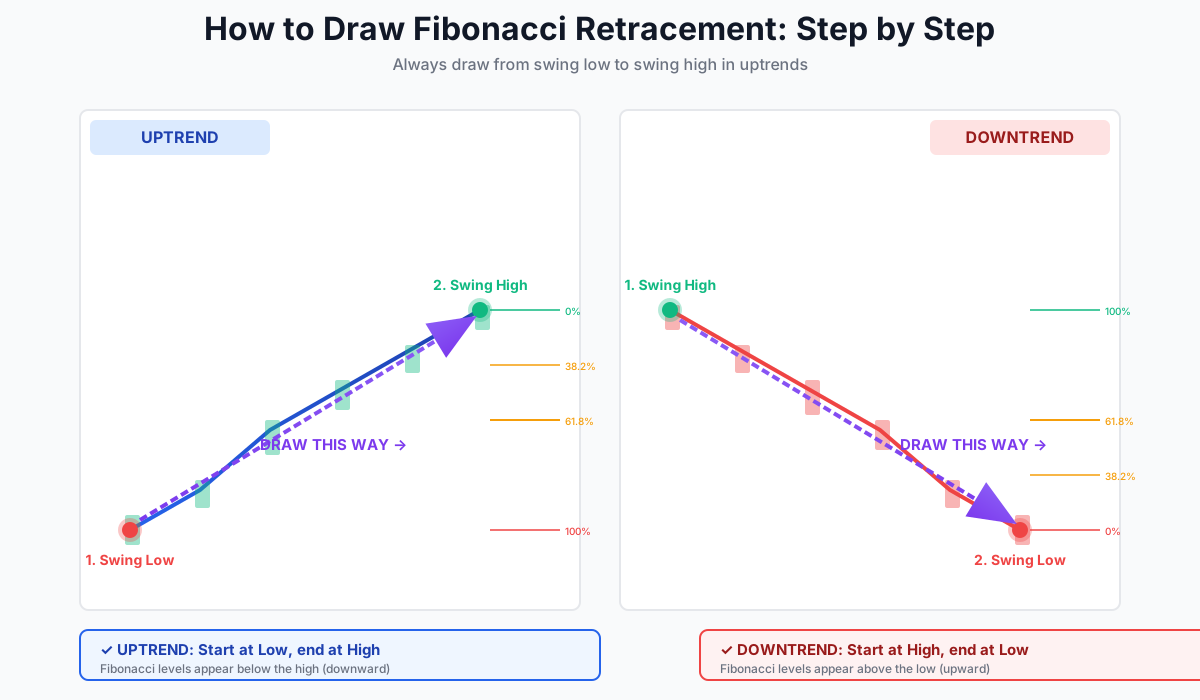
Draw from swing low to swing high in uptrends; reverse for downtrends
Step 4: Use Higher Timeframes for Reliability
Fibonacci levels drawn on 5-minute charts produce noise. Use daily or 4-hour charts for swing trades, or hourly charts at minimum for day trades. The higher the timeframe, the more reliable the level because more participants respect it.
Which Fibonacci Levels Work Best?
Not all Fibonacci levels are equal. Based on institutional usage and backtesting data, here's what matters:
| Level | Strength | Best Use Case |
|---|---|---|
| 38.2% | Strong | Strong trends, first bounce target |
| 50% | Very Strong | Psychological level, high liquidity |
| 61.8% | Strongest | Golden ratio, highest probability reversal |
| 78.6% | Moderate | Deep retracement, potential trend exhaustion |
| 23.6% | Weak | Too shallow, rarely holds |
The 61.8% level is the most reliable. If you only watch one Fibonacci level, make it this one. It represents the golden ratio and is where the majority of institutional buy and sell orders cluster. The 50% level is second-best due to psychological significance—traders instinctively expect halfway retracements.
The 38.2% level works in explosive trends where pullbacks are shallow. The 78.6% level signals trouble—if price retraces this deep, the original trend may be losing momentum, and you should tighten stops or exit.
Three Fibonacci Trading Strategies
Strategy 1: The 61.8% Bounce (Safest)
Wait for price to retrace to the 61.8% level in an uptrend. Enter a long position when price shows a reversal signal (bullish candlestick, volume spike, or RSI divergence). Place a stop loss just below the 78.6% level to protect against a full trend reversal.
Example: A stock rallies from $100 to $120, then pulls back. The 61.8% retracement sits at $107.60. You enter long when price bounces off $107.60 with confirmation, targeting a move back to $120 or higher.
Strategy 2: Multiple Level Confluence
Fibonacci levels become exponentially stronger when they align with other technical levels—a previous support/resistance zone, a round number, or a moving average. If the 50% Fibonacci level coincides with the 200-day moving average and a prior swing low, that zone has triple confirmation and a much higher probability of holding.
Scan your chart for these confluences. A Fibonacci level sitting alone is decent. A Fibonacci level overlapping two other respected zones is gold.
Confluence is King: Combine Fibonacci with Support Levels
The most powerful Fibonacci setups occur when a retracement level aligns with a horizontal support/resistance zone OR a rising trendline. This double confirmation dramatically increases your win rate. Learn exactly how to identify and trade these confluence zones in our Support & Resistance vs Trendlines guide.
Strategy 3: Extension Targets (Profit Taking)
Once price bounces from a retracement level and resumes the trend, use Fibonacci extensions to project profit targets beyond the original high. Common extension levels are 127.2%, 161.8%, and 200%. These show where the trend might exhaust or where you should take partial profits.
If a stock bounces from the 61.8% retracement at $107.60 and breaks back above $120, the 161.8% extension projects a target around $132. This gives you a logical exit instead of guessing.
Common Fibonacci Trading Mistakes
Mistake 1: Using Fibonacci Without Confirmation
Problem: Blindly buying every time price touches a Fibonacci level without additional confirmation signals.
Solution: Always combine Fibonacci with at least one other signal—a reversal candlestick pattern, RSI divergence, volume increase, or a test of a prior support zone. Fibonacci shows WHERE price might reverse; confirmation shows WHEN it actually does.
Mistake 2: Drawing Fibonacci on Noise
Problem: Applying Fibonacci to small, insignificant price swings or low timeframes filled with random movement.
Solution: Only draw Fibonacci on clear, significant trends—at least 10% moves on daily charts or multi-hour trends on intraday charts. A 2% intraday wiggle does not warrant Fibonacci analysis. Bigger moves produce more reliable levels.
Mistake 3: Ignoring the Bigger Trend
Problem: Trading a Fibonacci bounce against the larger trend—buying a retracement in a broader downtrend.
Solution: Zoom out. If you are drawing Fibonacci on a 1-hour uptrend but the daily chart shows a downtrend, you are trading against the tide. Use Fibonacci only in the direction of the larger trend unless you are specifically scalping counter-trend bounces with tight stops.
Fibonacci vs Moving Averages: Which Is Better for Entries?
Both tools identify support and resistance, but they work differently and suit different strategies.
| Feature | Fibonacci Retracement | Moving Averages |
|---|---|---|
| Calculation | Fixed ratios from swing high/low | Rolling average of recent prices |
| Flexibility | Static levels, redrawn per swing | Dynamic, adjusts every bar |
| Best Use | Precise entries on specific pullbacks | Ongoing trend following |
| Setup Time | Manual, requires identifying swings | Automatic on all charts |
| False Signals | Fewer, but requires redrawing | More, but self-adjusting |
Fibonacci retracements give you specific price zones for entries, making them ideal for swing traders who want precise risk/reward setups. Moving averages provide continuous support and work better for trend-following systems where you stay in until the MA breaks. Many traders use both: Fibonacci to identify the entry zone, and a moving average to confirm the trend is intact.
How to Backtest Fibonacci Strategies
Before risking real capital on Fibonacci retracements, validate the approach with historical data. Here is how to backtest Fibonacci setups using QuantStock's backtesting tool:
- Define your swing identification rules: Use a fixed percentage (e.g., 10% swing) or pivot point logic to identify swing highs and lows programmatically.
- Select your Fibonacci level: Test the 61.8% level first, then compare results using 50% and 38.2% levels.
- Add confirmation filters: Combine with RSI, MACD, or volume to reduce false entries. Backtest with and without filters to measure improvement.
- Set stop loss and profit target: Place stops below the 78.6% level, and use extensions (127.2% or 161.8%) for profit targets.
- Run across multiple assets: Test on at least 10-20 different stocks or instruments over 2+ years to ensure the edge is not random luck.
A properly backtested Fibonacci strategy should show consistent performance with a win rate above 50% and positive expectancy. If your results are break-even or worse, the issue is likely poor swing selection or lack of confirmation filters.
Backtest Your Fibonacci Strategy Now
Validate Fibonacci retracement setups with real historical data before risking capital.
Start Backtesting More StrategiesTake Your Analysis Further
Fibonacci retracements work even better when combined with other technical tools. Strengthen your edge with these complementary strategies:
Support & Resistance vs Trendlines
When a Fibonacci level aligns with a horizontal support zone OR a rising trendline, you have double confirmation. Learn when to use each tool for maximum probability.
Master Support & Trendlines →EMA vs SMA Crossover Strategy
Use moving average crossovers to confirm the trend direction before entering at a Fibonacci level. Only take bullish Fib bounces when the EMA is sloping upward.
Learn MA Crossovers →Frequently Asked Questions
What is the most reliable Fibonacci retracement level?
The 61.8% level is the most reliable because it represents the golden ratio and is where institutional traders and algorithms concentrate orders. The 50% level is second-best due to psychological significance. If you only watch one level, focus on 61.8%.
Should I use Fibonacci retracement for day trading or swing trading?
Both, but with different timeframes. Swing traders draw Fibonacci on daily or 4-hour charts for multi-day entries. Day traders use 1-hour or 15-minute charts but must ensure the underlying trend is clear. Lower timeframes produce noisier signals, so always check higher timeframes before trading Fibonacci levels intraday.
Can Fibonacci retracement predict exact reversal points?
No. Fibonacci levels show zones where price is likely to find support or resistance, not exact reversal prices. Treat Fibonacci as probability zones, not guarantees. Always use confirmation signals (reversal candles, RSI divergence, volume) before entering at a Fibonacci level. The level shows WHERE to watch; confirmation shows WHEN to trade.
How often should I redraw Fibonacci levels?
Redraw Fibonacci levels after every significant swing high or low is established. For swing trading, this might be weekly or after a major trend move. For day trading, redraw each morning based on the previous day's range or the overnight session's swings. Avoid constantly redrawing intraday—pick your swings at the start and stick with them.
Do Fibonacci retracements work better in trending or ranging markets?
Fibonacci retracements work ONLY in trending markets. They measure pullbacks within a trend, so if there is no clear trend direction, the tool is useless. In ranging markets, use horizontal support and resistance levels instead. Identify the trend first—if it does not exist, do not use Fibonacci.
Start Trading Fibonacci Retracements with Confidence
Fibonacci retracement levels give you objective zones to enter trades during pullbacks instead of guessing or chasing. The 61.8% and 50% levels offer the highest probability entries, especially when they align with other support zones or confirmation signals.
The key to success is drawing Fibonacci on significant trends, combining levels with confirmation, and backtesting your approach before going live. With proper application and validation, Fibonacci becomes a powerful tool for timing entries and managing risk.
Ready to test Fibonacci strategies on real historical data? Use QuantStock's free backtesting tool to validate your setups and find which Fibonacci levels work best for your trading style and target markets.
Continue Your Trading Education
Don't stop here! Master complementary techniques to build a complete trading system: